

Website Development Process: Saving You From Chaos
“Good websites don’t appear out of thin air. They are planned, organized, questioned, built, tested, and launched with a purpose.” — Conrad Strabone, Managing Partner & President | e9digital
When the value of a website is unclear, users leave web pages within 10 to 20 seconds. It is the digital equivalent of trying to hail a cab on a rainy afternoon in Midtown. You either make your move fast, or someone else gets the opportunity.
A real website development process makes or breaks a project. It gives strategy, messaging, design, development, testing, and launch a clear order, so the final website is not held together by last-minute decisions and crossed fingers.
A lot of businesses think website development is simple: design, development, launch. That is how companies end up with delayed timelines, vague copy, missing pages, broken forms, confusing navigation, and a site nobody truly planned.
This guide breaks down the seven steps that keep website projects organized, practical, and tied to business performance.
What Is a Website Development Process?
“A website development process is the framework that keeps a website from becoming a pile of bad decisions.” — Conrad Strabone, Managing Partner & President | e9digital
Think of the website design and development process as the structured sequence a team follows to plan, design, build, test, launch, and maintain a site. That sounds simple, but if you skip a step, it becomes a problem later.
Think of it like purchasing a brownstone. You would not pick the paint color before checking the layout, wiring, and foundation. A website works the same way. The visible layer matters, but the structure underneath determines whether the whole thing holds.
A strong website development process usually includes:
- Planning and business goals
- Sitemap and page architecture
- Content and messaging
- Design and user experience
- Development and CMS setup
- QA, SEO, testing, and launch prep
- Post-launch maintenance and improvement
This matters even more for NYC businesses. In a dense, competitive market, your website has to earn credibility quickly. People compare options fast. They scan your services, judge your polish, look for proof, and decide whether you feel legitimate before they ever fill out a form.
A sloppy process gets exposed faster here in NYC. The market is too crowded, the buyer is too busy, and the expectations are too high. Website strategy should never be treated like a nice extra. It is the blueprint before the build.
The 7-Step Website Development Process for NYC Businesses
The best website development process steps make the project cleaner. They give the team a shared sequence so the website is not being invented in pieces by whoever happens to be in the meeting that week.
If these steps happen in the right order, the site has a much better chance of supporting the business instead of becoming another digital headache.
Step 1: Discovery and Strategy
Figure out what the site is supposed to do before deciding what it should look like.
Discovery is where you figure out your key performance indicators (KPIs) for your site. What does the business need the website to improve? Acquire talent? More qualified leads? Better hiring? Stronger credibility? Clearer services? A smoother sales process? Better support for campaigns?
The work usually includes:
- Defining business goals, audience needs, core offers, and conversion priorities
- Reviewing competitors and market expectations
- Identifying the pages and functionality the site actually needs
- Clarifying what success should look like after launch
This is also where assumptions get challenged. A business may think it needs 40 pages, when it really needs 12 strong ones. Another may think the homepage is the whole problem, when the real issue is service page clarity.
A site without strategy can still look fine. Plenty of buildings in New York have a polished lobby and questionable plumbing upstairs. The question is whether the website helps someone understand, trust, and act.
Step 2: Sitemap, Architecture, and Content Planning
Build the skeleton before dressing the website for opening night.
Once strategy is clear, the next move is structure. This is where the team maps pages, content hierarchy, and user pathways. It is much easier to fix confusion in a sitemap than after pages are written, designed, and defended.
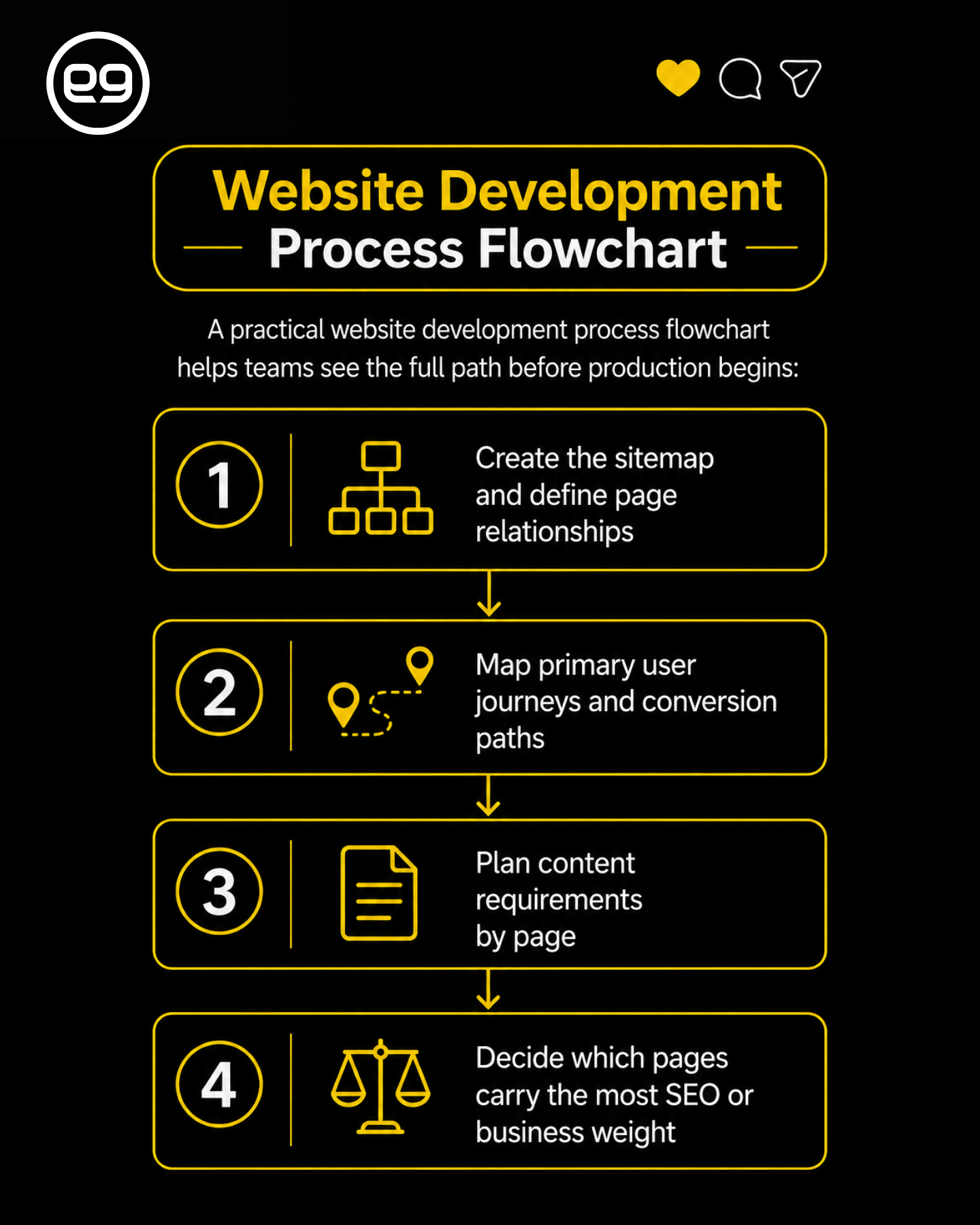
A practical website development process flowchart helps teams see the full path before production begins:
- Create the sitemap and define page relationships
- Map primary user journeys and conversion paths
- Plan content requirements by page
- Decide which pages carry the most SEO or business weight
Architecture also affects search visibility. Crawlable links and clear structure help Google find and understand site pages. Site architecture works like Manhattan’s numbered streets and avenues: it gives people a logical way to understand where they are and where to go next.
Step 3: Content and Messaging
Copy closes the deal, but only if it knows what it is selling.
This is where the content gets built: headlines, page copy, proof points, CTAs, FAQs, bios, service explanations, and brand tone. A lot of businesses treat content like a side quest, then act surprised when the site looks clean but says nothing useful.
A strong website development process checklist should make content part of the build early.
Content should clarify:
- What the business does
- Who it helps
- Why the offer matters
- What the user should do next
For NYC businesses, generic copy is especially risky. Buyers are comparing options quickly. If the site sounds like everyone else, the business becomes easier to ignore. At e9digital, our copywriters work in tandem with our designers and our clients to maximize conversion rates.
Step 4: Design and UX
Do not go so flashy with the design that you distract someone off your own website.
Now the site starts to look like something real. This is where layout, brand expression, visual hierarchy, navigation, mobile behavior, and page flow come together.
But design should not be judged by polish alone. A dramatic homepage can still fail if the user cannot figure out where to go.
A strong website design and development process uses design to support clarity and movement. The user should know what matters, where to look, and what action makes sense next.
Good design should prioritize:
- Clear navigation: The menu and page links are easy to understand, so visitors can quickly find what they came for without guessing.
- Strong visual hierarchy: The page is organized so the most important information stands out first, using layout, size, spacing, and contrast to guide attention.
- Mobile-first layouts: The website is designed to work well on phones first, so users can read, tap, scroll, and act easily on smaller screens.
- Readable copy and accessible design: The words are easy to scan, and the design works for as many people as possible, including users with visual, motor, or cognitive limitations.
- Obvious conversion paths: The site makes the next step clear, whether that is contacting the business, booking a consultation, making a purchase, or filling out a form.
Users form first impressions in about 50 milliseconds, according to three studies. That means every visual decision is doing part of the trust-building work.
In New York terms, good UX is like good signage in Penn Station. Nobody notices it when it works, but everyone feels the pain when it does not.
Step 5: Development and CMS Build
This is where good design either becomes a strong website or a future maintenance problem.
Development turns design into a functioning website, with templates, modules, forms, integrations, mobile behavior, performance setup, and CMS (content management system) structure.
If the build is weak, the site may look fine on launch day but become a maintenance headache later. Simple edits become complicated. Pages break. Forms misfire. Plugins pile up like unopened mail in a lobby.
A smart WordPress website development process should make the site usable for both visitors and the client team managing it after launch.
The development phase usually includes:
- Building the site in the selected CMS
- Configuring templates, forms, and integrations
- Optimizing for mobile and performance
- Making content updates manageable after launch
WordPress remains a major platform choice for many businesses, powering 41.9% of all websites and 59.5% of websites with a known CMS as of May 2026.
Still, the right platform depends on the job. WordPress, Webflow, Shopify, or another setup should be chosen because it fits the business, not because it is trendy.
Step 6: QA, SEO, and Pre-Launch Testing
Test before the website embarrasses you down the road.
This is where the team checks every part of the website to make sure it runs smoothly. A lot of people want to rush this step. Then they launch with broken forms and blame the platform.
Pre-launch QA belongs in every serious ecommerce website development process, service website, nonprofit site, and B2B build. The more the website has to do for the business, the more testing matters.
Before launch, the team should check:
- Forms, links, navigation, and user flows
- Mobile layouts across key screen sizes
- Metadata, redirects, and indexing settings
- Page speed and performance
- Analytics and conversion tracking
A 1-second load delay can cause a 7% loss in conversion. That makes speed testing part of business protection, not technical fussiness.
Think of QA like a final walk-through before opening a new office. You check the lights, locks, phones, signage, and front door before clients start showing up.
Step 7: Launch, Monitoring, and Maintenance
Launch day is not the finish line.
A website launch is the start of the live version of the job. Once the site is out in the world, real users begin interacting with it. That is when monitoring, maintenance, and improvement become essential.
Post-launch work should include:
- Pushing the site live with the right redirects and settings
- Monitoring analytics, form activity, and performance
- Maintaining software, plugins, content, and security
- Using real data to improve important pages
This is where many websites start to lose momentum. Nobody completes updates. Plugins age. Copy goes stale. Forms stop working. The site slowly becomes the digital version of a great office with flickering lights and old signage.
For e9digital, launch is not the moment the relationship ends. It’s the pivotal moment where the next phase begins: maintenance, measurement, and smart improvement.
Why NYC Businesses Need a Structured Website Development Process
“Your website is the thing that is 100% under your control. You control the message, the design, the user experience, the credibility, and the path people take when they arrive. If you are not doing the best possible job with that, every other marketing investment has less room to work.” — Conrad Strabone, Managing Partner & President | e9digital
NYC is not a forgiving place for weak websites. Competition is tight, expectations are high, and people have alternatives. A potential client can compare five firms between subway stops, skim your services before a meeting starts, and decide whether you feel credible before your homepage finishes making its case.
That is why a structured website development process is especially important here. A website has to communicate quickly, load cleanly, guide people clearly, and support the business without making users work too hard.
In a slower market, a confusing website might get a little patience. In New York, it gets replaced by the next browser tab.
A structured process helps NYC businesses avoid the usual project mess:
- Competitive markets reward clarity and speed
- Buyers compare options quickly
- Strategy keeps the site from becoming generic
- Clear UX helps users find the right next step
- Testing prevents embarrassing launch problems
For B2B companies especially, the website is often the first serious proof point. Before a prospect talks to sales, books a consultation, or asks for a proposal, they are judging whether the company seems organized, current, and capable.
That judgment does not happen in a vacuum. It is shaped by messaging, design, structure, speed, case studies, service clarity, and the small signals that say, “These people know what they are doing.”
That is where strategy matters most for our team at e9digital. Good web design and development should reflect the reality of an NYC client: smart audience, high expectations, limited patience, and no shortage of competitors.
How To Create an MVP Website Development Process
“Some websites need 40 pages. Most need a clearer plan and fewer people panicking in the meeting.” — Conrad Strabone, Managing Partner & President | e9digital
Some businesses do not need a huge website out of the gate. They need a smaller, sharper first version that launches efficiently, proves the offer, and leaves room to expand. That is where an MVP (minimum viable product) website process makes sense.
MVP does not mean sloppy. It means focused.
A strong MVP approach is especially useful for startups, new service lines, campaign-specific launches, early-stage B2B companies, and businesses that need to move quickly without building more than they can manage.
The goal is to identify what the website truly needs for the first version.
A practical website development step-by-step process for an MVP usually includes:
- Start with the must-have pages only
- Focus on one or two core conversion actions
- Keep messaging tight and clear
- Build on a flexible CMS so expansion is easier later
- Launch, measure, and expand based on real behavior
For example, an MVP site for a B2B consulting firm might only need a homepage, services page, about page, case study page, contact page, and a few strong proof points. That may be enough to explain the offer, build trust, and generate qualified inquiries.
The mistake is thinking “small” means “unfinished.” A lean website should still feel intentional. It should still have clear messaging, clean UX, strong design, working forms, analytics, and enough structure to grow.
Think of it like opening a focused restaurant in the West Village. You do not need a 12-page menu on day one. You need a sharp concept, a strong kitchen, and a room people understand the second they walk in.
The Most Commonly Used Website Development Tools
“The tools matter, but only when they help the work move cleaner, faster, and with fewer surprises.” — Conrad Strabone, Managing Partner & President | e9digital
Website development tools can sound intimidating if you are not living inside the build every day. But the basic idea is simple: different tools help teams plan, design, code, review, test, and manage the site.
A strong website development process checklist should include the tools needed to keep the project organized. The exact stack depends on the site, but most professional teams use a mix of design tools, development tools, feedback tools, and CMS platforms.
Here is the user-friendly version:
- VS Code is where developers write and edit code
- Git and GitHub help teams manage a website’s coding, track changes, and avoid overwriting each other’s work
- Chrome DevTools helps developers test layouts, fix issues, and check performance in the browser
- Figma is used to design pages and review layouts before development
- Pastel helps teams leave comments directly on web pages during review
- WordPress is a common CMS for content-heavy business websites and has it’s own hosting.
- Node.js and npm support more technical builds that rely on modern JavaScript tools
For many agency and small business projects, a practical starting stack is Figma for design, WordPress or Webflow for the site build, GitHub for version control, Chrome DevTools for testing, and Pastel for feedback.
The point is not to collect tools like subway delays. The point is to use the right ones so the team can design clearly, build safely, review efficiently, and launch with fewer issues.
Common Website Development Process Mistakes
“You can’t invest good money in your marketing to send people to a website that does not convert. That is like spending a fortune inviting people to a party, then no one answers the door.” — Conrad Strabone, Managing Partner & President | e9digital
Projects go sideways because strategy was skipped, content was delayed, feedback got messy, development was rushed, or nobody owned QA and maintenance. The mistakes are usually predictable, which is good news. Predictable problems can be prevented.
An example of a weak website development plan process happened to one of our clients who hired only a freelancer. The project started with excitement, then decisions began piling up and there simply weren’t enough hands on deck.
When this happens, the most common mistakes include:
- Starting design before strategy is defined
- Leaving content until too late
- Choosing a CMS without thinking long-term
- Underestimating QA and launch prep
- Treating launch like the end instead of the midpoint
The biggest mistake, though, is treating processes like bureaucracy. Good process is not red tape. It is scaffolding. It lets the team do better work without dropping pieces into the street.
For NYC businesses, that discipline matters. The website has to hold up in a competitive market where credibility, clarity, and speed all count. A structured process does not guarantee perfection, but it gives the project a much better success rate.
A Better Process Usually Produces a Better Website
“Get the website your business needs by hiring an agency with 100+ 5-star reviews.” — Conrad Strabone, Managing Partner & President | e9digital
The right website development process ensures a high-quality final site. Your company receives clearer strategy, stronger UX, cleaner development, fewer launch problems, and a website that supports the business instead of becoming next quarter’s frustration.
e9digital brings structure to website strategy, web design, development, WordPress planning, and ongoing maintenance, so “we need a new website” turns into a business tool that drives leads. With 60% business from referrals and 40% business from SEO, we know what we’re doing.
Ready to build a website with a clear process from A to Z? Contact our team today to get started.
FAQ: Your Questions Answered for the Website Development Process
What Is a Website Development Process?
A website development process is the structured sequence used to plan, design, build, test, launch, and maintain a website so it performs well for the business.
It keeps the project from becoming a scramble of late decisions, unclear ownership, missing content, weak UX, and launch problems that could have been avoided.
How Many Steps Are Usually in a Website Development Process?
Most agencies break the website development process into 5 to 7 steps, but the exact number matters less than what gets covered.
Strategy, content, design, development, QA, launch, and maintenance all need a place in the process, or the website can start strong and fall apart fast.
What Is the Difference Between Frontend and Backend Development?
Frontend development is what users see and interact with on the website. Backend development is what powers the site behind the scenes.
In a strong website design and development process, both sides need to work together. The site should look polished, function properly, load efficiently, and be manageable for the team after launch. It should be a well-oiled machine, like the backstage crew and actors on a long-running Broadway play.
Why Does a Website Development Process Matter for NYC Businesses?
A website development process matters for NYC businesses because competitive markets expose weak strategy, weak UX, and weak launches faster.
Prospects compare options quickly here. If the website feels confusing, dated, slow, or thin, there is usually another firm one tab away that looks more prepared.
How Do You Create an MVP Website Development Process?
You create an MVP website development process by starting with the core pages, clearest messaging, and essential functionality only.
Launch the focused version first, measure what works, and expand from there. MVP does not mean unfinished. It means the first version is disciplined, useful, and built with room to grow.
Does the Website Development Process Affect SEO?
Yes, a strong website development process supports SEO through sitemap planning, content structure, crawlability, performance, redirects, metadata, and launch QA.
SEO problems often start before launch. If the site structure, content, and technical setup are not handled properly, search visibility can suffer before the website has a real chance.