

SEO for Financial Services Is About Trust
Financial services is one of those industries where trust matters before the first conversation. People are cautious; when they don’t have a clear picture of their financial goals, have an increasing tax burden, or need protection for large assets, they want to turn to experts. But they don’t pick the first one. They compare. They ask around. Then they search.
96% of Americans planning to hire a financial advisor intend to do further research online before making a decision. If your firm is invisible in search, your reputation only helps the people who already know your name.
How many clients are you missing out on because your firm’s website doesn’t show up where your clients are looking?
But don’t panic; financial services SEO can help you show up where you need to be at the exact moment your clients are ready to make a decision.
A strong SEO strategy needs to be paired with strong website content, helping a prospect answer questions like:
- Does this firm understand my situation?
- Do they specialize in the kind of help I need?
- Do they seem credible enough to contact?
- Is the website clear, polished, and easy to navigate?
Your SEO rankings matter, of course. But rankings without credibility are like a packed exhibition at The Met with no wall text. People may show up, but they will not know what they are looking at or why it matters.
What Is SEO for Financial Services?
“SEO is not a lottery ticket. If it were that easy to spend a little and get a fortune back, every one of your competitors would already be doing it.” — Conrad Strabone, Managing Partner & President | e9digital
SEO for financial services is the process of improving a financial firm’s visibility in search results so the right people can find it when they are actively researching services, advice, or expertise.
In plain English: it is the work that helps your firm get found by the people who are already looking.
That includes on-page SEO, content strategy, local SEO, technical SEO, search intent mapping, internal linking, and credibility-building signals that help both users and search engines trust what they are seeing.
Financial SEO usually has to account for:
- Higher trust thresholds: Prospects need to feel confident that the firm is credible before they are willing to start a conversation.
- Longer decision cycles: People often compare multiple firms, revisit websites, and take time before reaching out.
- Education-heavy search behavior: Many prospects are looking for answers before they are ready to choose a provider.
- Local and niche competition: Firms may need to stand out in a specific city, neighborhood, service category, or client segment.
Someone searching for a restaurant in SoHo may make a decision in twelve minutes. That’s why 97% of Americans plan to interview multiple financial advisors before they make a decision. That requires a lot more time.
Why SEO Matters for Financial Services Firms
“A financial firm can be excellent at what it does, but if the website does not make that obvious, the firm is leaving trust and money on the table.” — Conrad Strabone, Managing Partner & President | e9digital
Financial SEO services give your firm more ways to be found by people who are already looking for specific help, whether that is retirement planning, wealth management, tax strategy, business-owner planning, or another service area.
The problem with weak SEO for financial firms is not always obvious at first. The phone may still ring, referrals may still come in, and existing clients may still be happy.
But growth gets narrower.
Without a strong search presence, financial firms often end up depending on the same few channels: referrals, personal networks, paid campaigns, and repeat business. Those channels can work, but they can also limit how many new prospects discover the firm on their own.
A stronger SEO presence can help a firm:
- Expand discovery: More prospects can find the firm without needing a direct introduction.
- Support niche services: Specific pages can bring attention to specialized offerings that may not be obvious from the homepage.
- Create more durable visibility: Organic search can keep working after a campaign, event, or referral push ends.
- Improve lead quality: Search intent helps connect the firm with people who are already researching a relevant need.
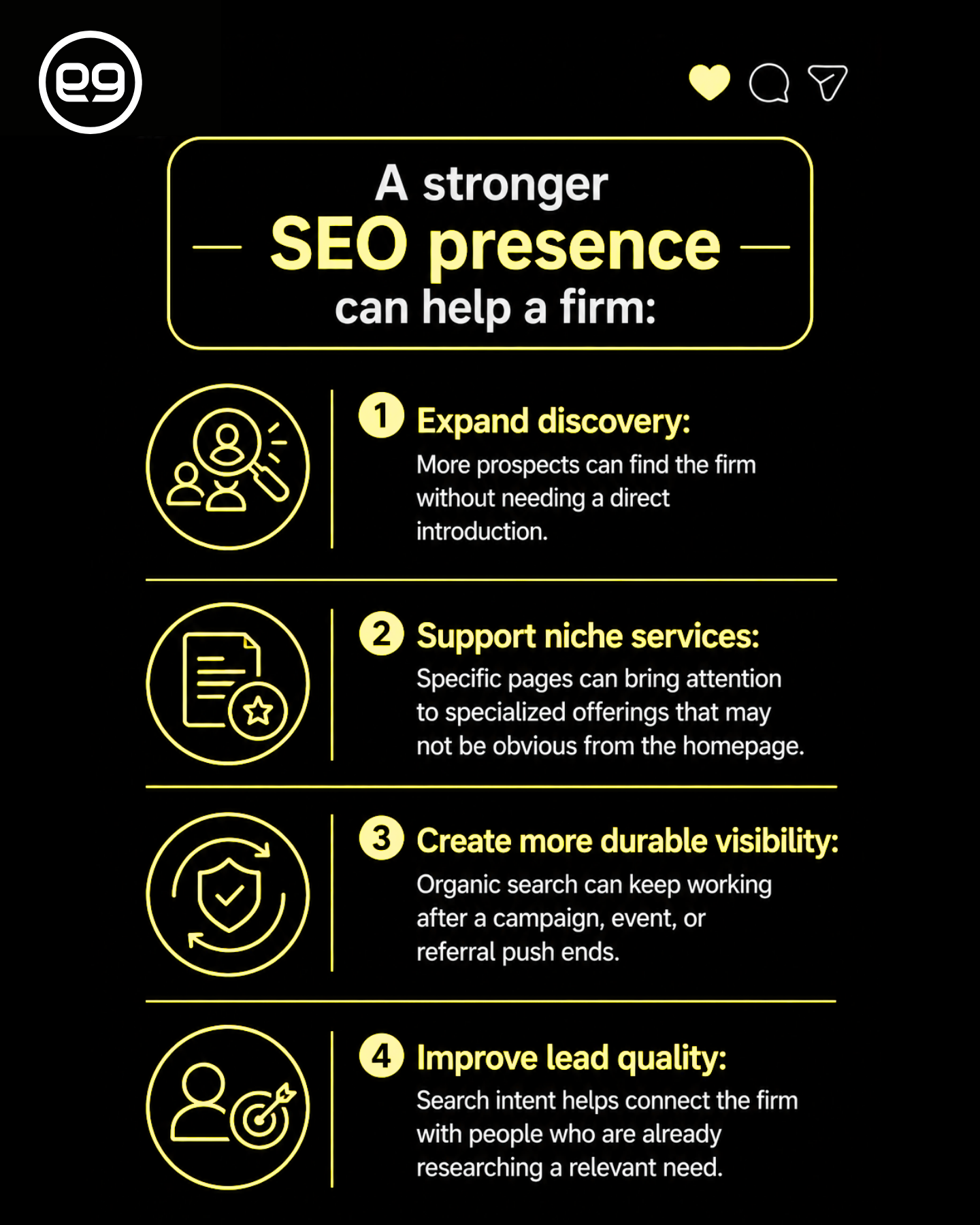
The business case for SEO is that it gives financial firms more surface area in the market.
In a category where many firms sound similar, that matters. The firm that explains its services clearly, shows up for relevant searches, and gives prospects a reason to keep reading has a better chance of turning online research into a real conversation.
The 6 Core Pillars of SEO for Financial Services
The work of a financial services SEO company tends to fall apart when it is treated like a quick visibility fix. Finance is too competitive, too trust-driven, and too detail-sensitive for that. A firm can rank for the wrong terms, attract the wrong visitors, or bring people to pages that do not make a strong enough case.
The better question is not “Are we doing SEO?” It is “Are the right parts of our digital presence working together well enough to turn search interest into real consideration?” That is where the core pillars come in.
1. Service-Page and Solution-Page Optimization
Service pages need to be built around how prospects actually search, not how the firm organizes its internal offerings.
That means each page should focus on one clear intent. A retirement planning page should not also include estate planning, tax strategy, business-owner planning, and investment management. That kind of page may feel efficient internally, but it usually becomes vague for search engines and harder for prospects to understand.
From there, the page should be easy to scan. Use one unique H1, descriptive H2s, and copy that matches the language prospects use when searching. A strong financial service page often moves from the problem, to who it is for, to how the service works, to key benefits, proof points, FAQs, and a clear CTA.
2. Educational Content
Financial buyers tend to research heavily because the stakes feel personal, expensive, and long-term. That makes educational content especially valuable.
A stronger service page should open by making three things clear:
- The problem: What issue, decision, or need is the prospect trying to solve?
- The audience: Who is this service actually for?
- The credibility: Why is this firm qualified to help?
The goal is not to publish for the sake of publishing. Nobody needs another sleepy blog post floating around the internet like a forgotten flyer on the subway platform.
The goal is to answer the questions prospects are actually asking.
3. Technical SEO
Technical SEO is the behind-the-scenes work that helps search engines crawl, understand, and evaluate the website.
It is not always glamorous, but neither is the subway signal system. When it works, nobody thinks about it. When it breaks, everything slows down.
For financial services firms, technical SEO agencies like e9digital implement best practices such as:
- Keep key pages crawlable and indexable: use clean robots rules, XML sitemaps, canonicals, and noindex only where appropriate.
- Make the site fast and stable, especially on mobile: Core Web Vitals and page speed matter for both rankings and conversions.
- Use HTTPS everywhere and avoid mixed content: security is a trust signal in finance.
- Ensure important content renders without issues: including JavaScript-heavy pages, calculators, and forms.
- Establishing compliance: Keep disclosure and disclaimer text visible on-page and easy to access on mobile.
- Maintain a clean site architecture: logical navigation and strong internal linking to core service pages.
4. Trust Signals
Trust signals matter in every industry, but they carry extra weight in finance.
Prospects want to know they are dealing with a serious, credible firm. Search engines also look for signs that a website demonstrates experience, expertise, authority, and trustworthiness, especially in sensitive topics like money and financial decision-making.
Useful trust signals can include:
- Credentials: Licenses, certifications, and qualifications that show the firm has the expertise to advise clients responsibly.
- Leadership bios: Clear profiles that help prospects understand who is behind the firm and why they are credible.
- Service explanations: Specific, plain-English descriptions of what the firm does and who each service is for.
- Case studies: Real examples, where appropriate, that show how the firm solves problems or supports clients.
- Press mentions: Media features or industry recognition that reinforce authority.
- Testimonials: Client feedback, when allowed, that gives prospects additional confidence.
If the website, Google profile, service pages, and search snippets all feel like they came from different firms, confidence takes a hit.
5. Internal linking and Site Architecture
For a financial services website, internal linking means linking one page on your own site to another page on your own site. For example, your main “Wealth Management” page might link to a page about retirement planning, and that retirement page might link back to the main service page.
This helps visitors move around your site more easily, and it helps search engines understand which pages are most important.
Site structure covers how your website is organized. Think of it like a filing cabinet. The most important pages should be easy to find, and related pages should be grouped together in a logical way. A good structure usually looks like this: homepage at the top, then main service pages, then more specific pages underneath those, like sub-services, FAQs, or helpful articles.
A good rule of thumb is:
- Put your most important services in the main menu.
- Link related pages to each other where it makes sense.
- Use clear page names, not clever or vague labels.
- Make sure important pages are not hidden too deep in the site.
6. Measurement and SEO analytics
SEO should not run on guesswork.
Analytics help firms understand which pages attract qualified traffic, which searches are gaining visibility, which content supports conversions, and where the website may be losing people.
A strong financial services SEO agency tracks:
- Organic traffic: The number of visitors who come to your site from unpaid search results.
- Keyword rankings: Where your pages appear in search results for the terms you want to target.
- Click-through rate (CTR): The percentage of people who see your result in search and actually click it.
- Conversions: The number of visitors who complete a goal, like filling out a form, calling, or booking a consultation.
- Search visibility: How often and how prominently your site shows up across a group of important keywords.
Local SEO for Financial Services: Where a Lot of the Real Opportunity Lives
Organic search drives 53% of all trackable website traffic. For firms that serve specific cities, boroughs, neighborhoods, or regions, local SEO is a major part of the strategy.
Google says local results are based primarily on relevance, distance, and prominence. That gives firms a clean framework: make it clear what you do, where you do it, and why your firm is credible enough to be shown.
A strong local SEO foundation usually includes:
- A complete and accurate Google Business Profile
- Consistent name, address, and phone information
- Clear service categories
- Strong reviews and reputation signals
- Localized service pages where appropriate
This is especially important in a market like New York—which is unusually crowded with 2.6 million small businesses. That’s the most in any U.S. metro area.
Financial SEO Content Strategy: Showing Clients Your Expertise
A lot of financial websites say the same vague things: personalized service, tailored strategies, client-focused advice, long-term relationships.
Fine. But that language is not doing much to help search visibility or buyer confidence.
Good SEO content for financial advisors answers real questions, clarifies services, explains specialization, and helps a prospect feel smarter, safer, and more confident in the firm. If the content sounds generic, the differentiation usually disappears.
Strong financial content should usually include:
- In-depth service pages with clear explanations
- FAQ content tied to real prospect questions
- Educational blog posts around planning and decision-making
- Local content where geography matters
- Internal links that guide users toward relevant services
- Clear calls to action that make the next step easy
But volume is not the point. A website full of thin, repetitive content is like a diner that serves weak coffee. People order it not knowing any better, but they will never come back.
The better move is useful specificity. A financial firm should explain what it does in language real prospects use and answer the questions that come up before the first meeting.
Website Quality Still Matters in SEO for Financial Services
SEO can get the right person onto the website, but it cannot make a weak website suddenly persuasive.
That part is still on the website itself: the UX, the content credibility, the clarity, the structure, and whether the next step feels obvious.
A strong financial-services website should make it easy to understand:
- Who the firm serves
- What services it offers
- Why the firm is credible
- Where the firm works
- What the prospect should do next
If the firm ranks well but the site feels generic, outdated, or hard to trust, the SEO is doing half the work alone. In financial services, that is a real problem.
Finance SEO has to connect with design and user experience. Mobile accounted for 51.04% of worldwide web traffic in May 2026, which means a financial-services site that still treats desktop as the only serious experience is behind.
The best financial websites often feel like a well-run New York office: sharp, organized, efficient, and easy to navigate. That kind of clarity helps users and supports SEO.
What Are SEO Tactics for Financial Services?
For finance industry SEO, the practical playbook usually includes:
- Build stronger service pages: Each major service should have a clear page that explains what the firm offers, who it helps, and why someone should care.
- Improve local SEO: Your firm should be easy to find in local search results, especially if prospects are searching by city, neighborhood, or “near me” terms.
- Publish helpful content: Blogs, FAQs, and resource pages should answer the questions prospects are already asking before they contact a firm.
- Make the site easier to navigate: Internal links and clear page structure help visitors move from one useful page to the next without getting lost.
- Fix technical issues: The website should load quickly, work well on mobile, and be easy for Google to crawl and understand.
- Use analytics: Data should show which pages bring in the right visitors, where people drop off, and what should be improved next.
- Connect design to trust: The site should look polished, but it also needs to make the firm feel credible, clear, and easy to contact.
The biggest mistake is treating these tactics as separate chores. They need to work together.
A service page should connect to related educational content. Local visibility should connect to a credible website. Analytics should inform what gets improved next. Design should support conversion instead of simply looking polished.
That is how SEO becomes useful: a system that helps the right people find the firm, understand the firm, and feel ready to start a conversation.
SEO vs PPC for Financial Services: Which Is Better?
For financial firms, SEO and PPC should not be treated like a cage match. They solve different problems.
A strong financial planner SEO strategy should look at timing, budget, competition, and how much trust a prospect needs before reaching out.
In practical terms:
- SEO builds long-term visibility: It helps the firm show up organically for important services and questions over time.
- PPC creates faster reach: It can put the firm in front of a targeted audience right away.
- SEO supports credibility: Strong organic pages can make the firm feel more established.
- PPC supports testing: Paid campaigns can show which messages, offers, or services get attention fastest.
The best strategy often uses both. PPC can test demand. SEO can build durable visibility around what works. The goal is not to pick a side. It is to know which channel should lead based on what the firm needs right now.
Why NYC Financial Firms Need to Think More About SEO
New York is a hard place to sound generic. Prospects have too many options, and search makes those options easy to compare.
That is why SEO for financial advisors in NYC needs to be specific, not broad. A firm should make the essentials clear fast:
- Services: What does the firm actually do?
- Audience: Who is the firm best built to help?
- Location: Where does the firm work?
- Credibility: Why should a prospect trust it?
- Difference: Why choose this firm over the next one?
Local and niche positioning matter more here because the market is crowded. A vague “financial services firm” message will usually lose ground to competitors speaking directly to business owners, executives, families, founders, retirees, or high-net-worth individuals.
In New York, clarity is not cosmetic. It is how a firm earns a second look.
e9digital: Your Financial Services SEO Agency Partner
“The smartest clients are not trying to become SEO experts. They are smart enough to hire experts, collaborate with them, and let them do the job properly.” — Conrad Strabone, Managing Partner & President | e9digital
SEO should make your firm easier to find, trust, and contact. If it is only producing rankings, it is not doing enough.
At e9digital, we build customized financial SEO strategies that connect search visibility to the pieces that actually drive inquiries:
- Clear service pages that explain what you do and who you help
- Useful content that answers real prospect questions
- Local SEO that helps the right market find you
- Analytics that show what is working
- Website design that builds confidence fast
For financial firms, especially in New York, prospects compare quickly. Your site cannot feel vague, dated, or disconnected from the reputation you have built offline.
e9digital helps financial services firms turn SEO into a stronger business-development tool. If your search presence is not bringing the right people closer to a conversation, it is time to fix that.
Ready to make your firm easier to find, trust, and contact? Contact us to learn how we can build a strategy for real visibility and stronger leads.
Financial Services SEO Frequently Asked Questions
Does SEO Help Financial Advisors and Planners Get More Leads?
Yes. SEO can help qualified prospects find your firm during the research stage, when they are comparing options and deciding who deserves a conversation.
Online research is now part of the hiring process for the vast majority of prospective advisor clients. 96% of Americans planning to hire a financial advisor intend to do further research online before making a decision, and 97% plan to interview multiple advisors.
That makes visibility, website quality, and trust-building content important parts of lead generation.
Is SEO or PPC Better for Financial Services Firms?
SEO is usually better for long-term visibility and trust-building, while PPC is usually better for speed and immediate targeting.
Many firms benefit from using both. PPC can generate faster visibility and test messaging, while SEO builds a stronger long-term foundation. The right mix depends on the firm’s goals, market, budget, and timeline.
How Long Does SEO Take for Financial Services Firms?
Most financial services firms should expect meaningful SEO progress to take at least several months, especially in competitive markets or when the website needs stronger service pages, technical improvements, and trust-building content.
The timeline depends on the firm’s starting point, competition, location, website quality, and how consistently the SEO strategy is executed.
What Makes SEO for Financial Services Different from SEO in Other Industries?
SEO for financial services has to work harder to build trust. Prospects are often making serious decisions about money, retirement, taxes, investments, or business planning, so they need more reassurance before they reach out.
That means financial SEO needs more than keywords. It should combine clear service pages, educational content, credentials, strong local signals, technical health, and a website experience that makes the firm feel credible and easy to contact.