

Key Takeaways:
- Law firm SEO helps firms get found when potential clients are actively searching for legal help.
- Strong SEO depends on local visibility, service pages, technical performance, content, reviews, and internal linking working together.
- Rankings only matter if the website builds trust and turns visitors into calls, forms, and consultations.
- e9digital helps law firms connect SEO, website design, UX, content, and conversion strategy into one stronger client-acquisition system.
Law Firm SEO: Get Found by the Right People at the Right Time.
Organic search drives about 53% of law firm website traffic, outperforming every other channel. That makes law firm SEO less of a marketing “nice to have” and more of a must-have to grow your firm.
Today’s legal clients search first. They compare firms, scan reviews, read bios, and judge the website before they ever call.
Legal searches are usually high-intent. Nobody searches for an attorney because they are bored. Good law firm SEO helps your firm show up when someone is already looking for legal help.
A strong SEO strategy helps your firm:
- Show up for relevant legal searches
- Build trust before the first call
- Support referrals after someone Googles your name
- Compete in the right local market
- Turn website traffic into real consultations
What Is Law Firm SEO?
“If you’re the best lawyer in New York but your website makes you look average, you’re leaving cases on the table before the phone ever rings.” — Conrad Strabone, Managing Partner & President | e9digital
Law firm SEO is the process of improving your law firm’s visibility in search results so potential clients can find you when they are actively looking for legal help. It helps your firm rank for the right searches from your target market and turn those visits into consultations.
A good law firm SEO strategy usually includes:
- Practice-area pages that match client searches
- Local optimization for the firm’s service area
- Technical SEO so Google can crawl the site
- Content that answers real questions
- Trust signals that make the firm feel credible
- Clear calls to action that make contacting the firm easy
Law firm SEO is more specialized than generic SEO because legal services are high-trust and location-sensitive. A weak restaurant website may still get walk-ins. In comparison, a weak law firm website can lose the call before anyone speaks to the attorney.
Search gets people to the door. The site has to make them comfortable enough to walk in.
Legal SEO: Clients Don’t Hire What They Don’t See
A law firm can be excellent and still lose business online if the right people never find it.
Most legal clients do some homework before calling. They search the problem, compare firms, check reviews, and look for proof that the attorney understands their situation. If your firm is not visible in that process, you are relying on people to find you another way.
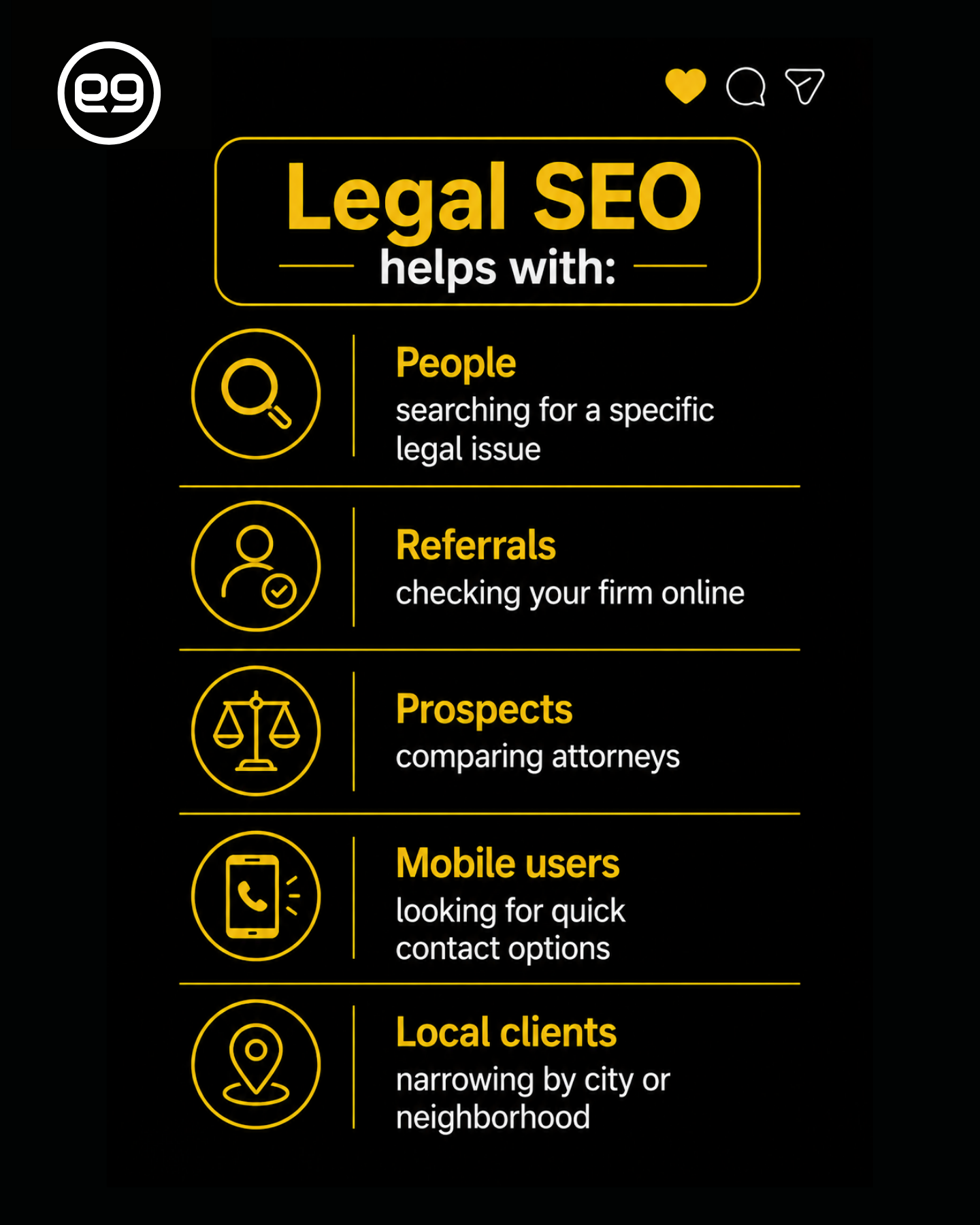
Legal SEO helps with:
- People searching for a specific legal issue
- Referrals checking your firm online
- Prospects comparing attorneys
- Mobile users looking for quick contact options
- Local clients narrowing by city or neighborhood
The 7 Core Pillars of Law Firm SEO
SEO for law firm growth is not about sprinkling keywords onto a few pages and hoping Google sends clients your way. Instead, it’s about implementing these seven core pillars (which is what we do for our clients).
Each strategy supports the others: local SEO helps people find you, content helps them understand you, reviews help them trust you, and UX helps them contact you.
When those pieces are aligned, SEO becomes more than visibility. It becomes part of intake.
1. Local SEO and Google Business Profile
Law firms are not trying to reach everyone. They are trying to reach the right clients in the right geography. That makes law firm SEO services especially dependent on local search.
In NYC, people search by borough, neighborhood, practice area, and urgency (many New Yorkers don’t have cars, unlike other areas of the country). A person may go as deep as “estate planning lawyer Upper East Side” because location helps them choose.
If your firm is weak locally, prospects may not be able to find you when they are ready to act.
Local SEO usually includes:
- A complete Google Business Profile: A fully filled-out profile with accurate services, hours, photos, categories, and contact details.
- Accurate name, address, and phone information: Consistent business information across the website, Google, and other online listings.
- Review generation and professional responses: A steady process for earning client reviews and replying in a polished, appropriate tone.
- Location pages where appropriate: Dedicated pages for key cities, boroughs, or service areas the firm actually serves.
- Localized practice-area content: Service pages that connect legal topics to the specific market or community the firm serves.
Google’s local framework comes down to relevance, distance, and prominence. For law firms, that means you need to match the search, serve the geography, and look credible enough to be shown.
2. Practice-Area and Service-Page Optimization
Too many firms treat service pages like a directory and only include a short paragraph or a list of practice areas. That is not usually enough to rank.
Each major practice area should usually have its own page. If the firm handles several related services, those may need their own supporting pages too. For example, an alcohol, food, and cannabis business lawyer will need different service and industry pages to cover the breadth of their scope.
Strong service pages usually include:
- A clear page title tied to the service: A specific title that tells visitors and search engines exactly what legal service the page covers.
- Local language where it makes sense: References to the city, borough, or service area when location is relevant to the search.
- A simple explanation of the issue: Plain-English copy that helps visitors understand the legal problem and why it matters.
- Details about the process: A brief breakdown of what clients can expect when working with the firm on that matter.
- Attorney credentials and trust signals: Bios, experience, awards, reviews, or memberships that help prove the firm is credible.
- Helpful FAQs: Clear answers to common client questions that support both SEO and user confidence.
- A visible contact prompt: An easy-to-find call to action that tells visitors how to call, schedule, or request a consultation.
A good test is simple: if someone searches for the service plus the city, would this page feel like the best answer?
If not, the page probably needs more focus, stronger content, or a clearer local angle (which a law firm SEO agency like e9digital can help you with).
3. Website Structure, UX, and Mobile Performance
SEO may bring someone to the website, but the website still has to do the selling. If the site is confusing, slow, crowded, or hard to use on a phone, good rankings can turn into missed calls.
That is why law firm SEO experts look at structure, UX, and mobile performance together. They are not separate problems. They are the online version of whether a client can find your office, understand where to go, and feel like they are in capable hands.
A strong law firm website should include:
- Simple navigation: A clear menu structure that helps visitors quickly find the services, attorneys, and contact information they need.
- Clear practice-area hubs: Main pages that organize related services under each major area of law.
- Descriptive URLs and headings: Page links and headings that clearly explain what each page is about.
- Internal links between related pages: Links that guide visitors and search engines from one relevant page to another.
- Attorney bios that support credibility: Profiles that highlight experience, credentials, practice focus, and trust-building details.
- Contact information on key pages: Phone numbers, forms, or scheduling options placed where visitors are most likely to act.
- Fast mobile loading: Pages that load quickly and work smoothly for users searching on phones.
- Tap-friendly buttons and forms: Mobile-friendly calls to action that are easy to press, read, and complete.
4. Technical SEO
Technical SEO is the foundation. It is not glamorous, but neither is the subway track under Manhattan. When it works, people do not think about it. When it breaks, everything backs up.
For law firms, technical SEO helps search engines crawl, index, and understand the site. It also helps people use the site without delays, errors, or broken paths.
A law firm can have strong content and still underperform if the technical setup is weak. Important pages may load slowly, get buried too deep, compete with duplicate pages, or fail to appear properly in search.
Even worse, if you try to DIY technical SEO, clients often end up doing worse on Google. An established SEO agency makes sure that your site is easy for Google to read and find.
Technical SEO:
- Makes your site easy to crawl with a logical hierarchy, clear internal linking, and few unnecessary clicks between pages.
- Keeps site speed strong, because slow pages hurt both user experience and search visibility.
- Uses responsive, mobile-friendly design, since Google evaluates the mobile version first.
- Secures the site with HTTPS and maintains valid SSL certificates.
- Ensures the site works for people with disabilities, including proper heading structure, alt text, and accessible forms.
Structured data can also help search engines understand the firm’s business details, services, attorneys, and locations more clearly.
The rule is straightforward: if a page matters for helping new clients understand your services, it should be fast, secure, mobile-friendly, easy to crawl, and easy to understand.
5. Content and FAQ Depth
A lot of legal websites say very little. They have thin service pages, vague blog posts, and bios that sound like they were assembled from a Squarespace template.
That does not give Google much to rank. More importantly, it does not give potential clients much reason to trust the firm.
Good legal SEO NYC content answers real questions before the consultation. It explains the issue, clarifies the process, and helps someone understand whether your firm is the right fit.
However, every page should not be a legal textbook. It means the content should be useful, specific, and written for actual people.
Strong legal content often includes:
- Clear practice-area explanations
- Common client questions
- Process breakdowns
- Local context
- Attorney insights through blogs, newsletters, or case studies
- Internal links to related services
- FAQs that address real concerns
An agency like e9digital knows how to create in-depth content that serves your potential clients and helps you rank higher on Google.
6. Reviews and Trust Signals
Legal clients are cautious because they are choosing someone to help with something personal, expensive, stressful, or business-critical (or all four).
That makes reviews and trust signals a major part of law firm SEO company NYC work.
Reviews can support local visibility, but they also shape whether someone clicks, calls, or keeps comparing. A firm with strong reviews, detailed attorney bios, clear credentials, and a professional website feels more credible before the first conversation.
So what’s a trust signal? Anything that helps a potential client understand your expertise and authority, which includes:
- Google Business Profile reviews
- Professional review responses
- Attorney bios with credentials and focus areas
- Testimonials where ethically allowed
- Awards and memberships
- Consistent business information
- Secure, polished website design
The point of content is to reduce doubt. In a crowded legal market, trust is often the difference between a visitor and a consultation.
7. Internal Linking and Crawlability
Internal linking is how a law firm website tells Google what matters. It is also how visitors move from one useful page to the next without getting lost.
Think of it like signage in Penn Station. Without clear direction, people may technically be inside the system, but they’ll be stressed about where they’re supposed to go for their 5:08 train.
Internal links should connect practice-area pages, related service pages, attorney bios, FAQs, blog posts, and location pages. That helps search engines understand the site’s hierarchy and helps users find the next useful step.
Crawlability is the other side of the same issue. Search engines need to find your important pages without hitting broken links, orphan pages, accidental noindex tags, or confusing site structure.
A good rule: any page that could help win a client should be reachable within a few clicks from the homepage.
How Can Law Firms Measure and Track SEO Success?
Law firms should measure SEO by one basic standard: is it helping the firm get better opportunities?
Traffic matters, but traffic alone is not the win. A spike in visitors means very little if those visitors are not calling, filling out forms, booking consultations, or turning into the right kinds of clients.
Good legal services SEO NYC tracking connects search performance to business outcomes. Otherwise, it is like judging a New York restaurant by foot traffic past the window instead of how many tables are actually filled.
The most useful SEO metrics for law firms include:
- Organic traffic from search: The number of visitors coming to the website from unpaid search results.
- Keyword rankings for priority practice areas and locations: Where the firm appears in search results for its most important legal services and markets.
- Organic clicks and impressions: How often the firm appears in search results and how often people click through to the site.
- Contact form submissions from organic visitors: The number of website forms completed by visitors who came from search.
- Tracked phone calls from organic search: Calls generated by people who found the firm through organic search.
- Google Business Profile calls, clicks, and direction requests: Actions people take after finding the firm’s local profile on Google.
- Lead quality and signed-case value: Whether SEO leads are turning into worthwhile consultations, clients, and revenue.
Rankings are helpful, but they are not the whole story. If rankings improve and the phone does not ring, there’s a problem. The keywords may be too broad, the page may not be persuasive, the call to action may be buried, or the traffic may not match the firm’s actual services.
The best SEO dashboard for a law firm should show the full path: visibility, traffic, leads, consultations, and signed matters.
When SEO Isn’t Enough: Improve the Website Quality
“A referral can get someone to Google your name. Your website decides whether that referral turns into a call or dies on the sidewalk.” — Conrad Strabone, Managing Partner & President | e9digital
SEO can get the right person onto the website, but it can’t make a bad website suddenly convincing.
That part is still on the site: the structure, UX, proof, tone, clarity, and how easy it is for someone to take the next step.
For law firm SEO experts, website quality is part of the SEO conversation because search and conversion are connected. A firm may rank well and still lose leads if the site feels dated, confusing, slow, or generic.
Think of it like someone walking into a Park Avenue office and then leaving them in a dim hallway with no receptionist. The address helped. The experience did not.
Mobile usability matters. Clear navigation matters. Fast loading matters. Attorney bios matter. So do reviews, credentials, case-related proof points where allowed, and contact options that do not make users hunt.
For legal websites, trust is fragile. Your competition is always available to potential clients.
Law Firm SEO vs PPC: Which Is Better?
PPC stands for pay-per-click advertising. In search marketing, that usually means paid ads that appear above or alongside organic Google results. The firm pays when someone clicks the ad, which can make PPC useful when you want visibility quickly.
The better choice depends on what the firm needs.
SEO is usually better for long-term visibility, compounding value, and lowering dependence on paid traffic over time. PPC is usually better for speed, testing, and getting in front of searchers quickly.
For many firms, the real answer is not SEO or PPC but both at different times.
A good SEO strategy for law firms often looks at both channels clearly:
- SEO builds long-term search equity: Strong pages, content, local visibility, and technical improvements can keep working after the initial work is done.
- PPC can generate faster visibility: Paid campaigns can put the firm in front of searchers quickly, especially for competitive or time-sensitive services.
- SEO may become more cost-efficient over time: Organic visibility can reduce reliance on paying for every click.
- PPC gives more control over timing and targeting: Ads can be adjusted by location, keyword, budget, and campaign goal.
- Both channels need strong landing pages to convert: Traffic only matters if the page builds trust and makes contacting the firm easy.
Legal paid search can be expensive, especially in competitive practice areas and major cities. In the US, legal CPC costs on average around $4.26, with high-value legal keywords often costing much more depending on market and search term.
Think of it like this: PPC is renting an apartment. SEO is buying that historic brownstone in Brooklyn.
That does not make PPC bad. Sometimes renting the billboard makes sense. But if the firm wants a stronger long-term presence, SEO needs to be part of the plan.
How Much Does Law Firm SEO Cost?
Law firm SEO pricing depends on competition, geography, practice area, website condition, content needs, local SEO work, technical cleanup, and how aggressively the firm wants to grow.
So the honest answer is: it varies, but an average monthly cost for SEO is $1,000-$2,500. However, this number is just based on a survey, so expect the pricing to change drastically based on:
- How competitive the city is
- How competitive the practice area is
- How much content the site needs
- Whether the website has technical problems
- Whether the firm serves one location or several
- How quickly the firm wants to compete
A more competitive market like NYC usually requires more serious effort. A personal injury firm in Manhattan and a niche business law firm in Kansas are not playing the same game.
Cheap SEO can get expensive when it produces thin content, weak strategy, messy implementation, or reports that look busy but do not move the firm forward.
If the price sounds too good, it probably means the work is too thin.
Why NYC Law Firms Have to Think About SEO a Little Differently
New York is not a forgiving market for vague marketing or mediocre websites. There are 9.7k legal partners in NYC alone.
Competition is denser, legal categories are crowded, and clients have options. And the standard for credibility is higher because people here are used to comparing everything fast, from apartments to restaurants to professional services.
That makes the law firm SEO companies in NYC, like e9digital, work more competitive and more precise.
NYC law firms need to think carefully about:
- Borough and neighborhood search intent
- Practice-area competition
- Local trust signals
- Mobile search behavior
- Review strength
- Website quality
- Clear differentiation
That is why SEO in this market cannot be reduced to keywords alone. The firm has to be findable, credible, specific, and easy to contact.
In a city where everyone is competing for attention, the firms that win online are usually the ones that make the decision easier for the client.
Law Firm SEO Takes You From Keywords to Qualified Calls
“If an agency is selling you SEO but does not invest in its own visibility, that is not strategy. That is theory with an invoice attached.” — Conrad Strabone, Managing Partner & President | e9digital
For law firms, SEO should make the firm easier to find, trust, and contact when people are actively looking for legal help. That means the work has to connect search visibility to real business development.
At e9digital, we look at law firm SEO as part of a larger client-acquisition system. Technical SEO helps Google understand your site. Internal linking helps clients find what they’re looking for. Design builds confidence. Content answers the questions they are already asking. And we would know: 40% of our clients come from SEO.
If your law firm is ready to turn search visibility into actual opportunities, e9digital can help with SEO strategy, legal website design, UX, content, and conversion-focused digital marketing built for competitive markets like NYC.
Frequently Asked Questions
Does law firm SEO help get more clients online?
Yes, law firm SEO helps get more clients online by improving your visibility for searches people use when they need legal help.
It can bring more qualified visitors to your site, support referrals who Google your firm, and increase calls or consultation requests when the website is built to convert.
How long does law firm SEO take to work?
Law firm SEO usually takes several months to show meaningful results because search visibility builds over time. The break-even time for SEO averages about 14 months for law firms.
The timeline depends on competition, website condition, content quality, local SEO strength, and how aggressive the strategy is. In competitive markets like NYC, patience and consistency matter.
What makes law firm SEO different from regular SEO?
Law firm SEO is different from regular SEO because legal services are high-trust, local, and often urgent.
A law firm’s SEO strategy needs strong practice-area pages, local visibility, attorney credibility, reviews, compliance awareness, and clear conversion paths. The visitor needs confidence before they call.
Do law firms need local SEO?
Yes, law firms need local SEO because most legal clients search for attorneys in a specific city, borough, neighborhood, or service area.
Google Business Profile optimization, reviews, local pages, and consistent contact information help firms appear for searches with local intent.
Is SEO better than PPC for law firms?
SEO is better for long-term visibility, while PPC is better for fast placement and controlled campaigns.
Most law firms benefit from understanding both. PPC can create quick visibility, but SEO builds search equity over time and can reduce dependence on paid clicks.
What pages are most important for law firm SEO?
The most important pages for law firm SEO are usually practice-area pages, location pages, attorney bios, the homepage, contact page, and high-quality FAQ or blog content.
These pages help search engines understand the firm and help potential clients decide whether to reach out.
Can e9digital help with law firm SEO and website design?
Yes, e9digital can help with law firm SEO and website design by building the visibility, structure, content, UX, and conversion strategy needed to turn search traffic into qualified leads.
For law firms, that combination is critical. A site has to rank, but it also has to persuade.