

Branding Is the Reason People Come Back Again and Again
If you’re struggling with customers never coming back after one purchase, you may have a branding problem. 80% of people trust the brands they use, making your branding one of your most important marketing tactics.
In New York, plenty of places have a clean-looking sign out front. The ones people remember are the ones with a clear reputation, a recognizable feel, and a reason to come back. That’s your branding.
Branding is what gives people that memory. It tells them who you are, what you stand for, and why you are different from the next business in the search results.
A strong brand helps your business feel established before a sales call even happens, making your business easier to recognize and trust. A good branding strategy makes a business website more credible, memorable, and built to perform. And that’s what you need to generate more leads and sell more products.
What Is Branding? It’s Your Elevator Pitch
Branding is the set of signals people use to understand your company. That includes your visuals, your voice, your positioning, your reputation, and the experience people connect to your name.
Think of it like an elevator pitch people can absorb in 30 seconds without hearing the whole presentation. When the pitch is clear, people understand exactly what you offer, and this helps them trust you faster. And when consumers trust a brand, they are 63% more likely to buy from it, 55% more likely to stay loyal to it, and 53% more likely to advocate for it.
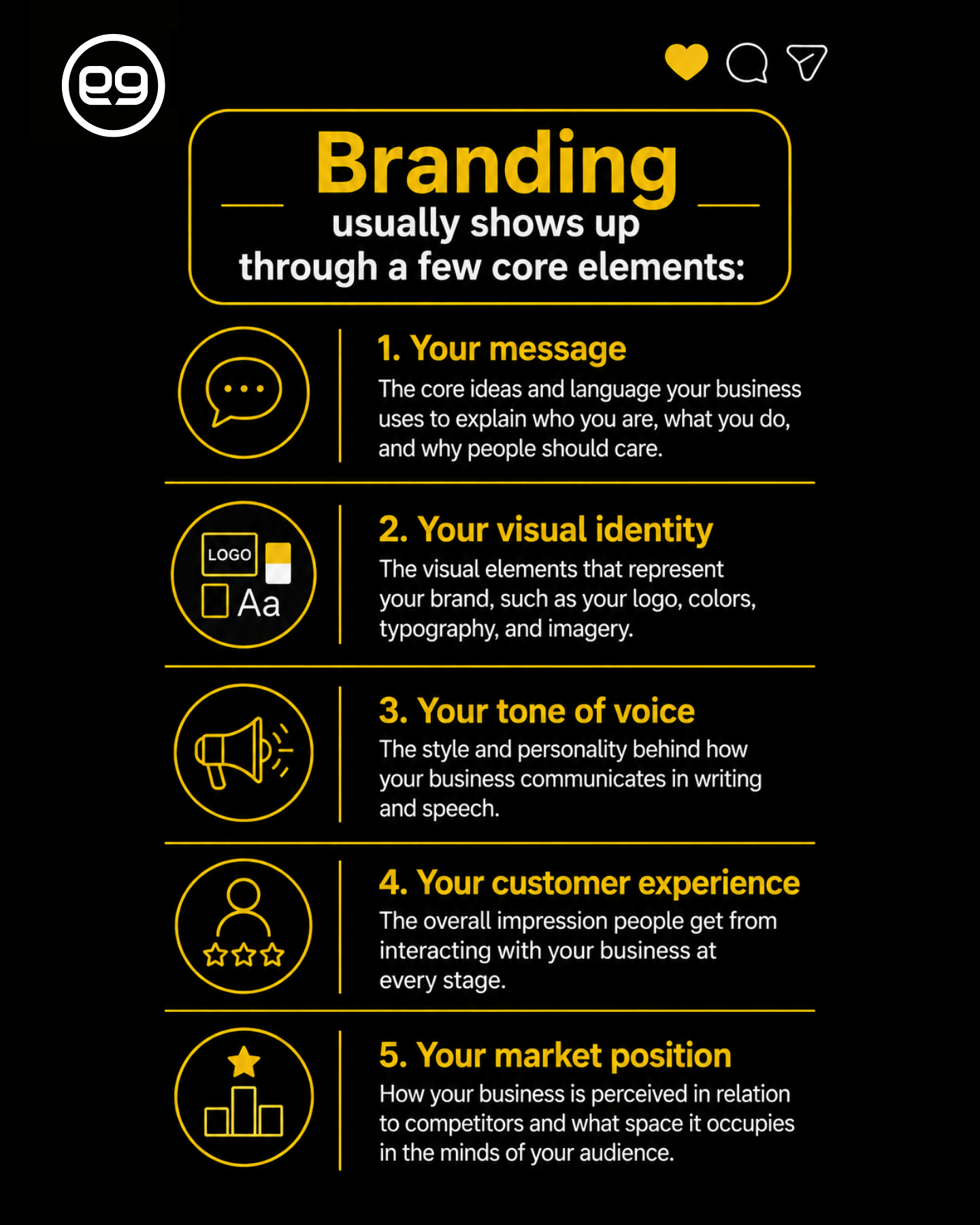
Branding usually shows up through a few core elements:
- Your message: The core ideas and language your business uses to explain who you are, what you do, and why people should care.
- Your visual identity: The visual elements that represent your brand, such as your logo, colors, typography, and imagery.
- Your tone of voice: The style and personality behind how your business communicates in writing and speech.
- Your customer experience: The overall impression people get from interacting with your business at every stage.
- Your market position: How your business is perceived in relation to competitors and what space it occupies in the minds of your audience.
When the brand planets align, people understand your business faster. When they do not, confusion creeps in. That confusion costs attention, trust, and conversions. Good branding gives people a clean read on who you are.
Why Is Branding Important? Generic Equals Replaceable
“Your website is the box your business comes in. Before anyone experiences your service, talks to your team, or understands how good you are, they are judging the packaging.” — Conrad Strabone, Managing Partner & President | e9digital
What does branding mean for a small business owner? It means you stop looking like everyone else. Buyers move fast. They are not reviewing every option like a panel of judges at a town hall meeting. They are scanning, comparing, and making quick calls about who feels credible.
A clear brand helps people make sense of your business faster. Businesses with a consistent brand see 10-20% revenue growth on average.
Strong branding helps you:
- Build trust faster
- Stand out without overwhelming your audience
- Support better marketing performance
- Compete on more than price
This is even more important for small businesses. Big brands can survive mixed signals for longer because they have budget and time on their side. Small businesses usually don’t. If the message is muddy, the trust gap shows up faster.
Think of it like this: generic businesses get treated like a sea of cabs in the rain. The second one disappears, people wave at the next one. Branding gives your business a reason to be remembered, and that makes every other marketing effort work harder in the right direction.
Brand Identity: The Part People See, Hear, and Remember
Branding for business starts with brand identity, which is how strategy gets translated into something visual and verbal that customers can recognize.
If branding is the reputation you want to build, identity is the face and voice doing the work. It includes the logo, but it also includes the rest of the system that holds your business together across channels.
Brand identity usually includes:
- Logo and logo variations: The primary logo and approved alternate versions used across different sizes, formats, and placements.
- Color palette: The set of brand colors used consistently across your website, marketing, and design materials.
- Typography: The fonts and text styles that help give your brand a recognizable visual tone.
- Image style: The look and feel of the photos, graphics, or illustrations associated with your brand.
- Brand voice: The distinct personality and tone your business uses in its messaging and communication.
- Messaging cues: The key phrases, themes, and language patterns that help reinforce your brand message.
- Usage rules across platforms: The guidelines that ensure your brand elements are applied consistently across websites, social media, email, and other channels.
The important part is consistency. A business should not sound polished on its website and random everywhere else. That is like a sleek Manhattan lobby opening into a cluttered back office. The disconnect makes people question the whole operation.
Brand Strategies: Before You Pick Colors, Pick a POV
Brand strategy is the plan that defines how your business will be understood by the people you want to reach. If you ignore strategy, branding turns into a group project where everyone argues over colors and nobody agrees on what the business should actually stand for.
And you need to know what your brand stands for, because 84% of people say they need to share values with a brand to use it. Brand strategy covers:
- Positioning: How your brand is placed in the market and what specific space it aims to own in the minds of your audience.
- Differentiation: What makes your business distinct from competitors and why someone should choose you over other options.
- Audience: The specific group of people your brand is trying to reach, influence, and serve.
- Messaging: The key ideas, language, and talking points your brand uses to communicate clearly and consistently.
A strong brand strategy makes marketing decisions easier. When you know what you stand for and how you want to be perceived, your website copy, social tone, ad messaging, and even SEO (search engine optimization) positioning become more coherent.
For small businesses, you often cannot outspend your competitors, so you need to be more memorable, specific, and consistent. Before you pick the colors, pick the meaning.
3 Steps to Create Cohesive Branding
Cohesive branding characteristics are what make a business feel consistent across every touchpoint. Your website, email, social media, proposals, and sales materials should all feel like they came from the same company; not copied and pasted, but clearly connected.
1. Start With Your Brand Foundation
“Branding starts with position, point of view, and purpose. The visual layer only works when it is built on top of something real.” — Conrad Strabone, Managing Partner & President | e9digital
Before you touch the visuals, get clear on the basics.
- Who are you trying to reach?
- What do you want to be known for?
- What should people feel when they come across your business for the first time?
Your foundation should define your point of view. But businesses have the tendency to jump into visuals before they have defined their position in the market. That is like opening a storefront in SoHo before deciding what you are selling. The space may look great, but people will still walk by confused.
For example, KFC started as “Kentucky Fried Chicken.” But all their customers started calling them KFC, so they shifted their approach to meet their needs.
Strong branding starts with clarity around audience, values, offer, and tone (like what we say on e9digital’s homepage). Once those pieces are in place, the rest of the brand has something real to stand on.
2. Build a Small but Clear Brand System
Most small businesses need a practical system people can use, not a 100-page brand deck. That means clear guidance for how the logo appears, which fonts and colors are approved, what kind of imagery fits the brand, and how the business should sound in writing.
A useful brand system should cover:
- Logo use: Guidelines for how your logo appears in different materials and placements.
- Typography: The fonts and text styles your brand uses to create a consistent look.
- Brand colors: The specific colors that visually represent your brand across channels.
- Imagery style: The look and feel of the photos, graphics, or illustrations.
- Messaging pillars: The core themes or ideas your brand returns to in its communication.
- Voice and tone: How your brand sounds in writing, including its personality and level of formality.
- Dos and don’ts: Specific examples that show what’s acceptable and what’s not for the branding.
3. Carry the Same Signals Across Every Touchpoint
Your brand should feel connected wherever people find you. The website should not sound one way while your emails sound another. Social posts should not feel casual and improvised if your proposals are trying to project authority. Every touchpoint does not need to look identical, but it should feel related.
That consistency should show up across everything from your website to social media to printed materials.
Explore Brand Varieties: Avoid the Sea of Sameness
Branding products and services is not one-size-fits-all. A law firm, a founder-led consultancy, a skincare line, and a neighborhood service company all need branding, but they do not need the same expression.
That is where a lot of businesses go wrong. They copy a style they like instead of building one that fits what they sell. Good branding should match the job.
Different brand types tend to emphasize different things:
- Service brands lean on trust and expertise
- Product brands lean on recognition and differentiation
- Personal brands lean on voice and authority
- Local brands lean on familiarity and community trust
A service brand should reassure people. A product brand should stand out fast. A personal brand should feel distinct and human. A local brand should feel known.
The point is not to force every company into the same creative mold. The point is to build the right brand for the business in front of you. And the right agency partner can help make that happen.
What Makes a Brand Successful?
When people ask what makes a brand successful, they often mean visual appeal. That is part of it, but only part. A successful brand is clear, consistent, recognizable, and trusted (think Nike, Apple, or Pepsi). It leaves a mark because people know what they are getting.
The strongest brands usually share a few traits:
- They are easy to understand
- They feel consistent across channels
- They stand for something specific
- They build trust over time
Brand success comes from being recognizable, steady, and relevant enough that people remember you when they are ready to act. That kind of brand makes marketing more effective because it gives people something solid to latch onto.
Branding Isn’t a First Date; It’s a Marriage
“Our team at e9digital is not here to make something that just looks good. We’re here to build something that makes the phone ring.” — Conrad Strabone, Managing Partner & President | e9digital
Branding characteristics matter most over time. Branding is not a one-time event. It is a relationship builder. It creates the long-term trust that keeps customers coming back and helps prospects feel more confident saying yes.
If people do not remember you, trust you, or understand why you matter, your marketing has to drag that weight uphill.
A strong brand should support your:
- Website
- SEO
- Email marketing
- Sales materials
- Lead generation efforts
That’s what we do at e9digital. We don’t hand over a style guide and ghost you. We help small businesses define their brand, sharpen their messages, and carry that identity across the channels that actually grow the business.
Frequently Asked Questions
How Often Should a Small Business Update Its Branding?
A small business does not need to reinvent its branding constantly, but it should review it whenever the business evolves. That usually means after a shift in audience, services, positioning, or growth stage. If the brand starts feeling inconsistent, dated, or out of step with the business, it is time for an update.
Can a Small Business Improve Its Branding Without a Full Rebrand?
Yes. A lot of businesses can improve their branding without starting over. Clearer messaging, stronger visual consistency, a more polished website, and better alignment across marketing materials can go a long way without requiring a full rebrand.
What Are the Signs Your Branding Is Hurting Your Marketing?
Common signs include inconsistent visuals, unclear messaging, weak differentiation, and a brand that does not inspire much trust. You may also notice that your marketing feels harder than it should, because people are not quickly understanding who you are or why they should choose you. This is often the time you need to bring in a branding agency.