

Content Marketing: Build Trust Without Buying Attention
Content marketing for small businesses is often one of the best ways a small business can explain what it does, build trust, improve search visibility, and keep attracting people after the ad budget stops talking.
According to 74% of marketers, content marketing helps generate demand or leads.
A lot of small businesses treat content marketing like the thing they will get to once the website is done, the phones are ringing, and someone has spare time.
So basically, never.
However, it is important to make time for it. 54% of all trackable web traffic is from organic search. If you are smaller, less known, or competing against firms with more money, content is one of the few ways to keep showing up without paying for every single click through Google Ads or PPC..
Think of it like a well-run construction site in Manhattan. People may notice the crane first, but the real confidence comes from seeing that the plan, crew, and process are clearly in place. This blog covers what content marketing is, why it matters, how to start, and how small businesses can use it to support real growth.
What Is Content Marketing for Small Businesses?
“A good piece of content is like a good sales conversation. It should make the prospect feel smarter, more comfortable, and more ready to take the next step.” — Conrad Strabone, Managing Partner & President | e9digital
Content marketing for small businesses is the practice of creating and distributing useful, relevant content that helps attract, educate, and convert the right audience over time.
That includes blog posts, articles, email content, landing pages, FAQs, case studies, videos, guides, and other assets that help people understand what you do and why they should trust you.
In plain English, it is the work of showing up with something helpful before asking somebody to buy.
Content marketing is bigger than blogging. It’s creating and distributing relevant material that audiences want, rather than relying only on direct promotion.¹
For small businesses, content has to do multiple jobs at once:
- Build trust with real people.
- Give search engines clarity about what the business offers.
- Support service pages and sales conversations.
- Answer questions before prospects reach out.
- Make expertise easier to understand.
Good content marketing is not “more content.” It is better-targeted, more useful content tied to what the business actually sells.
Why Do Small Businesses Need Content Marketing?
Small business content marketing helps a smaller business look more established, sound more useful, and keep showing up even when nobody is actively paying to boost the message.
Small businesses usually do not have endless ad budgets, giant sales teams, or universal name recognition doing the heavy lifting for them. That means they need other ways to build trust, stay visible, and explain what makes them worth choosing.
If your business is not famous, content helps familiarity happen anyway.
It is also cost-effective. Content marketing generates more than three times as many leads as outbound marketing and costs 62% less.2
For a small business, that matters because every dollar has a job.
What Good Content Marketing Actually Does for a Small Business
For a small business, that means your content needs to do more than attract attention. It should remove confusion, set expectations, and give prospects enough confidence to take the next step.
A strong content marketing strategy for a small business should support the moments when people are deciding whether to trust you, compare you, contact you, or keep looking.
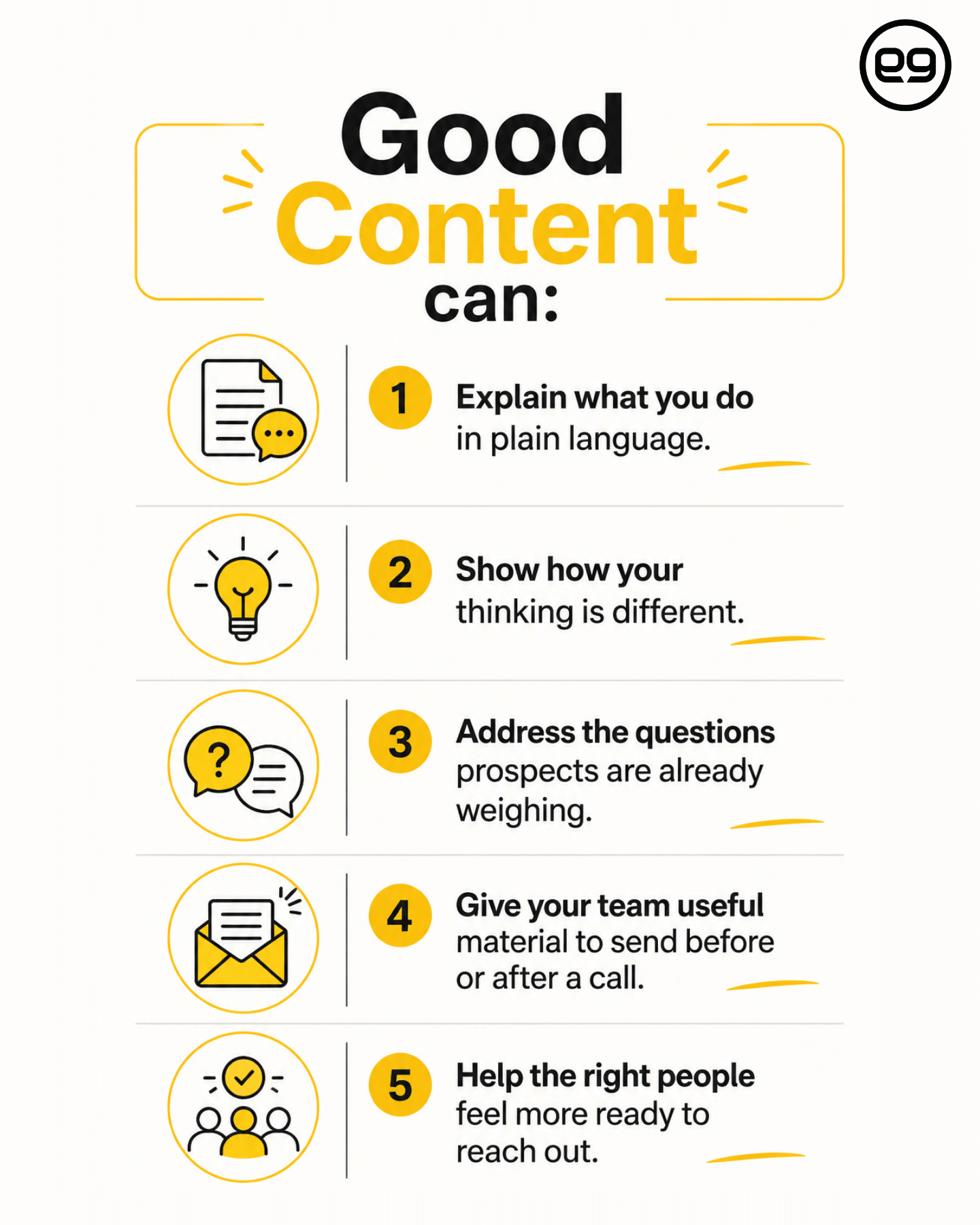
Good content can:
- Explain what you do in plain language.
- Show how your thinking is different.
- Address the questions prospects are already weighing.
- Give your team useful material to send before or after a call.
- Help the right people feel more ready to reach out.
49% of marketers say content marketing helped generate sales or revenue, which is an important reminder that content can influence real business outcomes.3
How Do You Do Content Marketing for Small Business? 5 Steps to Get Started
Small businesses do not need to turn into publishers to make content marketing work.
They need a practical starting point. That means knowing what questions to answer, which services to build content around, what formats they can actually keep up with, and how to get more value from every piece they create.
The content marketing tips for small businesses below walk through how to turn content from a “we should probably do that” idea into a realistic system your business can use consistently.
Step 1. Start with audience questions and customer pain points.
The best content ideas often come from the conversations your business is already having.
Look at emails, sales calls, reviews, contact forms, proposals, and FAQs. Pay attention to feedback from customers, especially around pricing, timelines, outcomes, risk, trust, and comparison.
A content bank can include:
- Common customer questions.
- Sales objections.
- Pricing concerns.
- Timeline questions.
- Service confusion.
- Local market questions.
- Problems customers are trying to solve.
These are the “money questions.” They influence whether somebody moves forward, delays, compares you to a competitor, or disappears.
A construction firm, for example, might answer “How long does a tenant improvement project take?” or “What permits are required in Queens?”
That kind of content works because it meets people where they actually are.
Step 2. Build content around actual services and search intent.
Good content should connect directly to what your business actually offers.
A strong content marketing strategy for small businesses looks at the difference between people who are just learning, people who are comparing options, and people who are ready to act.
That way, you are not creating content just to get clicks. You are creating content that can support real buying decisions.
Your content should connect to:
- Core services.
- Local search intent.
- Common buying questions.
- Service pages.
- Contact forms and conversion points.
- Topics that lead to qualified prospects.
For example, instead of writing a generic “What is SEO?” post, a digital agency could publish “SEO for Law Firms: What Actually Works.”
That is much closer to the business, the buyer, and the decision. The more specific you make it, the more searchable the post is on Google.
Step 3. Choose a few formats you can sustain.
A small business does not have to write content for every platform. It needs to be useful where your audience can find you consistently.
A small business content marketing strategy should be realistic enough that the team can actually follow it. One good blog post, one useful email, or one strong video can do more than ten half-finished ideas sitting in a calendar.
Start with formats that match your team’s time and strengths.
Good starter formats include blog posts, email newsletters, and short videos. 4
The goal is not to create the flashiest video. The goal is to keep showing up with something useful.
One well-written blog post can become an email, a few LinkedIn posts, a short video script, and a sales follow-up resource. That is how small businesses get more mileage out of the work.
Step 4. Publish consistently instead of chaotically.
Content marketing usually fails because there is no rhythm.
A realistic publishing cadence is better than an ambitious calendar that collapses after three weeks. For many small businesses, two to four strong pieces per month can be a good place to start.
The key is to connect the cadence to business goals, not random inspiration.
A simple content rhythm can include:
- Monthly service-focused articles.
- Seasonal content tied to demand.
- Case studies when projects close.
- FAQ updates based on sales questions.
- Email content that supports campaigns.
- Content refreshes for older posts.
Think of it like running a coffee shop. You cannot open the shop only when you feel inspired and expect customers to continue to visit.
Consistency builds familiarity. Familiarity builds confidence.
Step 5. Reuse good content across channels.
Small businesses do not have to create from scratch every time.
If a piece of content is useful, it should be used in more than one place. A blog post can become an email. An FAQ can become a social post. A webinar can become a guide. A case study can support sales conversations for months.
For example, a blog post on “Website Accessibility Basics” could become a checklist PDF, a webinar topic, and a series of short educational posts.
That is not cutting corners. That is using the same strong material the way a good contractor uses the right tool for more than one job.
What a Content Marketing Strategy for Small Business Should Include
A content marketing strategy should tell you who you are trying to reach, what they care about, what content you are making, where it goes, and how you will know if it is working.
For small businesses, strategy matters because time and attention are limited. You do not get to waste either one for long.
A strong content strategy should include:
- Target audience: The specific people you want to reach, including their needs, questions, problems, and decision-making concerns.
- Core topics and service themes: The main subjects your business should be known for, tied directly to what you sell.
- Content formats: The types of content you can realistically create, such as blogs, emails, FAQs, videos, guides, or case studies.
- Publishing cadence: A practical schedule for creating and publishing content without burning out the team.
- Distribution plan: The places your content will go after it is published, including search, email, social, and sales follow-up.
- Measurement plan: The numbers you will track to understand whether content is supporting traffic, leads, engagement, and revenue.
- Update/refresh plan: A system for improving older content so useful pages do not become outdated or lose performance.
Recent research says 61% of B2B marketers expect their organization to increase investment in video, while 52% expect more investment in thought leadership content.5
Even if a small business is not operating at B2B enterprise scale, that is a useful signal. Format choices matter. Thought leadership matters. And content should be planned like a business asset, not a side project.
The Best Content Types for Small Businesses
“Small businesses have great stories, deep experience, and real value. Content marketing gives all of that a place to show up and work.” — Conrad Strabone, Managing Partner & President | e9digital
Small businesses do not need to become super successful content creators. They need formats that are useful, realistic, and tied to what the business actually sells.
The best content types are usually the ones that help customers understand the offer faster and trust the business sooner.
If a format looks trendy but you cannot sustain it, it is probably not your format.
Strong content types can include:
- Blog posts and articles: Useful written content that answers questions, explains services, and gives search engines more context about your expertise.
- FAQs: Direct answers to common customer questions that can reduce confusion, support faster decision-making, and help your brand appear in AI search.
- Case studies: Real examples of your work that show what happened, how you helped, and why the result mattered.
- Email newsletters: Regular communication that keeps your business visible with prospects, clients, and referral partners.
- Short-form video: Quick educational or trust-building content that helps people see the people and thinking behind the business.
- Service-page content: Clear website copy that explains what you offer, who it is for, and why someone should contact you.
- Guides and checklists: Practical resources that help prospects understand a process, prepare for a decision, or evaluate their options.
The right mix depends on your business, your audience, and what you can keep doing consistently. A law firm, contractor, CPA firm, nonprofit, or financial advisor may all need content, but they do not all need the exact same content plan.
That is where strategy matters. The format should serve the business, not the other way around.
How Do You Measure Content Marketing Performance?
Measuring content marketing performance is one of the most useful parts of the process because a lot of content programs die from vagueness, not from lack of effort.
If nobody knows what success looks like, then every result gets interpreted emotionally.
Measuring content marketing performance does not have to be complicated, but it does have to be intentional. The point is not to count everything. It is to track the numbers that tell you whether the content is helping the business.
A practical measurement plan can include:
- Organic traffic: The number of visitors finding your website through unpaid search results.
- Rankings: Where your pages appear in search results for important keywords and service-related terms.
- Engagement: How people interact with your content, including time on page, scroll depth, clicks, and repeat visits.
- Email signups: The number of people who subscribe because they found the content useful enough to keep hearing from you.
- Form fills and leads: The inquiries, quote requests, consultations, or contact forms generated from content-driven visits.
- Assisted conversions: The times content supported a conversion, even if it was not the final page someone visited before contacting you.
- Sales conversations influenced: The moments when prospects mention a blog, guide, case study, email, or article during the buying process.
- Content decay and refresh opportunities: Older content that has lost traffic, rankings, or relevance and should be updated.
The goal is not to turn every small business into a data department. It is to know whether content is doing its job. If content is bringing in the right people, answering the right questions, and supporting the right conversations, that is meaningful progress.
Use AI Without Sounding Like Robots
AI has officially entered the content-marketing conversation whether people like it or not.
For small businesses, the practical question is not whether AI exists. It is how to use it without flattening the brand, killing quality, or publishing the same lifeless sludge everybody else is already posting.
Used well, AI can support ideation, repurposing, structure, and efficiency. Used badly, it makes the content easier to ignore.6
Small businesses can use AI to support content by:
- Brainstorming and outlining: Use AI to organize ideas, identify angles, and create a starting structure.
- Repurposing content: Turn one strong blog into emails, social posts, summaries, or short video prompts.
- Supporting drafts: Use AI to get a first version moving, then edit it heavily for accuracy, tone, and usefulness.
- Protecting brand voice: Keep human review in place so the content still sounds like your business.
- Avoiding generic output: Do not publish unedited AI content that could belong to any company in any industry.
AI is a tool. So is a power saw. That does not mean you hand it to anyone and hope the house comes out level.
The businesses that win with AI will not be the ones publishing the most. They will be the ones using it to work faster without sounding interchangeable. That’s why you can trust a team like e9digital to use AI to work more quickly but not compromise quality.
Content That Makes the Business Easier to Find, Trust, and Contact
The point of content marketing for small businesses is to make the business easier to find, easier to understand, and easier to trust before the sales conversation even starts. That means the content has to connect to search visibility, brand clarity, lead generation, and an actual plan for what happens next.
At e9digital, we build content around the way real customers search, compare, question, and decide.
That can include:
- Website content that explains services clearly.
- Blog content that supports SEO and customer education.
- Case studies that build trust with real examples.
- Email content that keeps prospects engaged.
- AI-supported content workflows with human strategy and review.
- Refresh plans that keep older content useful.
Good content should not sit on the website like furniture nobody uses. It should work like a good New York doorman. It gives people direction, builds confidence, and makes the next step easier.
If your business needs clearer content, stronger SEO support, or a more practical content marketing plan, e9digital can help. Schedule a call with our team and let’s talk about what your content should be doing for the business.