

Search Doesn’t End at the Click Anymore
For a long time, search followed a familiar pattern. People typed in a question, scanned a list of links, clicked a result, and landed on a website. That still happens, but it is no longer the whole story.
AI-generated search experiences are changing what happens between the query and the visit. Users are now getting summaries, comparisons, and direct answers before they ever reach a brand’s site. In many cases, that answer is enough.
This shift is already changing click behavior. For informational queries that trigger AI Overviews, organic click-through rate has dropped by ~55% year over year. We are inching closer and closer to a zero-click scenario, and your business needs to be prepared.
Now is your time to widen your marketing strategy, and here’s how GEO (generative engine optimization) fits into the picture.
What is GEO (Generative Engine Optimization)?
Generative engine optimization is the practice of structuring and strengthening your content so AI-driven search experiences like Perplexity and LLMs like ChatGPT are more likely to use it as a source in their answers.
Instead of competing only for a blue-link ranking, GEO is about being quote-ready for tools that summarize information. Imagine your content as a reference card a coach uses during a game: it needs to be accurate, specific, and easy to scan fast.
That usually means clear definitions, tight headings, straightforward explanations, and credible support for claims. The goal is to make it easy for an AI system to confidently pull a snippet, mention your brand, or include a link back when it can.
GEO is about making sure your content is not just present online, but usable in environments where more answers are now being delivered.
Why Your Business Cannot Ignore GEO Anymore
“If SEO gets you a storefront on Main St., GEO gets you the recommendation from the concierge who actually knows where the good stuff is.” — Conrad Strabone, Managing Partner & President | e9digital
AI search is training people to expect direct answers. Tools like Google AI Overviews, Perplexity, and ChatGPT are changing how people gather information. Instead of clicking through 15 tabs like they are doing research for a term paper, users are increasingly relying on summarized responses that do the sorting for them.
That shift affects visibility in three big ways:
- Users may get the answer before they ever reach your site
- Strong rankings do not guarantee strong traffic anymore
- Brands that are easy for AI to cite gain an early advantage
That is why generative engine optimization belongs in the mix. It is how you stay visible in a search environment where the answer is becoming the new homepage.
The Core Elements of GEO-Friendly Content
GEO-friendly content is content that AI systems can easily understand, trust, and reuse. That does not require gimmicks. It requires discipline.
At its core, generative engine optimization rewards content that is built to communicate clearly. The pages most likely to get included in AI-driven answers usually share the same characteristics:
- Answer-first writing: Lead with the main point, then add supporting detail. AI systems do not want to dig for the point anymore than readers do.
- Clear structure: Strong headings, short sections, bullets, and logical hierarchy make a page easier to parse and easier to quote.
- Topical authority: Strong pages stay focused on one subject, cover it thoroughly, and use related terms naturally so the content reads like a credible source.
- Trust signals: Facts, evidence, citations, company credibility, and transparent sourcing all help increase confidence in the content.
- Freshness: Updated information matters, especially on subjects that change quickly. Old content with stale facts starts to look like last season’s window display.
A good GEO paragraph is usually straightforward. It says what the answer is, explains why it matters, and adds enough context to make the recommendation useful.
If you only optimize for three things, make them the same three things that matter in any good business conversation: clarity, credibility, and structure. That is what helps content get cited instead of skipped. Using a simple FAQ format can be one of the best ways to get featured in AI Overviews.
How GEO and SEO Work Together
The conversation around SEO vs. GEO gets dramatic fast, which is funny because the smartest answer is also the least glamorous: you need both.
Here is the clearest way to think about it:
- SEO helps search engines find and rank your content
- GEO helps AI systems understand and reuse your content
- SEO drives visits from traditional search results
- GEO increases visibility before the click happens
- SEO is about discoverability
- GEO is about extractability and trust
That said, the overlap is real. A lot of what makes content strong in traditional search still helps in generative search too. Good content still walks in like it owns the room. Both GEO and SEO reward clear headings and logical structure, useful content that answers questions, and solid technical SEO that keeps pages accessible and crawlable.
The difference is not whether one replaced the other. The difference is that the rules of visibility expanded. The brands doing well now are not abandoning SEO. They are building content strong enough to perform in both environments.
5 Steps to Optimize Your Website for Generative Search
“If your page buries the answer like it’s hiding cash in a mattress, don’t be shocked when Google grabs somebody else’s cleaner version and puts them in the penthouse.” — Conrad Strabone, Managing Partner & President | e9digital
Optimizing for generative search is about making your content easier for AI tools to find, understand, trust, and reuse. These five steps focus on the practical changes that help your site become more visible in the places where search is heading.
1. Research Real User Questions
Start with what people are actually asking, not what sounds nice in a strategy deck.
Good generative engine optimization starts with real user intent. That means looking at customer questions, support tickets, sales conversations, search data, and FAQs (a huge part of AI search).
To ensure you catch the attention of your target market, you want to know:
- What prospects ask before they buy
- What they compare you against
- What confuses them
- What they need answered fast
This helps AI tools answer their questions and point them to your business. AI tools are built around prompts and questions, so your content should match that behavior. If your site only talks in polished brand language, it may miss the language real people actually use.
2. Answer Clearly and Directly
If the answer is hiding in paragraph four, you are already losing.
Directness matters. What is GEO in practice? It is often the difference between content that gets to the point and content that takes the scenic route.
Start sections with a clear answer. Then expand with detail, examples, or nuance.
That approach helps in two ways: readers find the point faster and AI systems can extract the answer more easily.
A page that makes users work too hard is like a 10-page restaurant menu with no categories and six different fonts. Technically, the information is there. But nobody enjoys the process.
3. Structure Pages for Easy Extraction
Organization is functionality, not decoration.
AI systems need organized content (your mother was right about keeping a clean room!). That means headings that make sense, concise paragraphs, bullets where needed, and a page structure that feels intentional.
This matters even more because AI Overviews often pull from eight sources on average for a single answer. You are competing to be one of the sources good enough to include.
Pages should be built so key information is easy to pull. That includes:
- Strong H2s and H3s
- Short, readable paragraphs
- Bullets for grouped ideas
- FAQs where relevant
- Clean formatting without clutter
4. Create Deep, Useful Topical Content
Thin content may fill a page, but it rarely earns trust.
To perform well in generative engine optimization, content needs enough depth to feel authoritative. That does not mean making every page longer. It means making every page more useful.
Strong topical content usually includes:
- A clear definition of the issue
- Practical explanations
- Examples or use cases
- Common mistakes
- Related follow-up questions
This is where a lot of brands get stuck in old-fashioned thinking. They publish surface-level content that sounds polished but does not actually help. AI systems are looking for visible expertise, not decoration.
5. Fix Technical and Local Visibility Signals
Even great content struggles when the site underneath it is held together with tape.
Technical clarity still matters for GEO.
If your site is hard to crawl, poorly structured, slow on mobile, or missing schema, you are creating friction for the systems trying to read and understand your content. If you’re new to technical website development, then you may need to bring on experts to do this properly.
Important areas to tighten up include:
- Schema markup: Code that helps search engines and AI systems understand what your content is about
- Crawlability: How easily platforms can access and read your pages
- Internal linking: Links that connect your pages and guide users and search engines through your site
- Mobile usability: How well your website functions on phones and tablets
- Accurate local business information: Consistent details like your business name, address, phone number, and hours
- Page speed and accessibility: How quickly your site loads and how easy it is for all users to navigate
You can write the smartest page in the borough, but if the platform cannot access it properly, it will not get cited.
GEO Mistakes to Avoid Like the R Train at Rush Hour
“A lot of websites are still dressed for 2007, and then they wonder why AI walks right past them like a bouncer at a Midtown club.” — Conrad Strabone, Managing Partner & President | e9digital
A lot of weak GEO work fails for the same reasons weak content has always failed. It buries the answer. It lacks structure. It says a lot without proving much.
The biggest GEO mistakes usually include:
- Burying the answer so users and AI systems have to dig through long intros
- Poor structure with dense text, weak headings, and no formatting to guide the page
- Thin or duplicate content that muddies authority and creates confusion
- Weak credibility signals like missing evidence, sourcing, or visible expertise
- Technical blind spots such as missing schema, crawl issues, or poor mobile performance
Companies lose ground in GEO without realizing it. They focus on publishing more when what they really need is content that is clearer, stronger, and easier to trust.
How to Measure GEO Performance
Sure, being on page 1 is great. But if you only look at SEO rankings, you are reading yesterday’s scoreboard.
Measuring GEO performance gives you a clearer view of how your business shows up in AI-generated answers, gets cited in meaningful ways, and turns that visibility into traffic, leads, or conversions.
The most useful GEO metrics include:
- Mention rate: How often your brand appears in AI answers
- Citation or attribution rate: How often the platform links to or credits your content
- Share of voice: How visible you are compared to competitors across target prompts
- Positioning or prominence: Whether your brand appears early in the answer or gets buried
- Referral traffic and conversions: Whether AI-driven visits lead to engagement, leads, or revenue
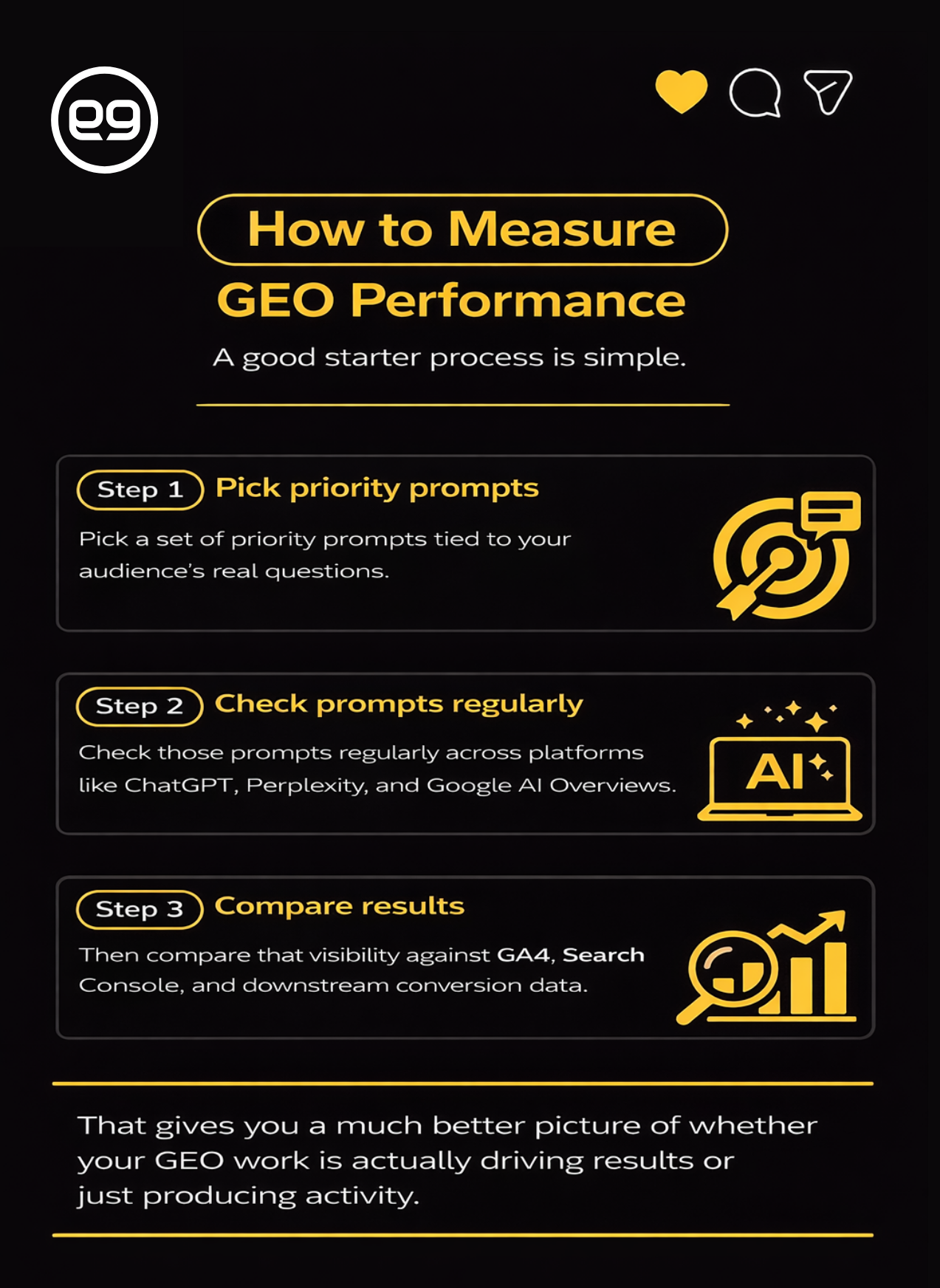
A good starter process is simple.
Step 1. Pick a set of priority prompts tied to your audience’s real questions.
Step 2. Check those prompts regularly across platforms like ChatGPT, Perplexity, and Google AI Overviews.
Step 3. Then compare that visibility against GA4, Search Console, and downstream conversion data.
That gives you a much better picture of whether your GEO work is actually driving results or just producing activity.
Your Competitors Started GEO Six Months Ago. It’s Your Turn
Search changed clothes, but the job is still the job. You need to be seen, understood, and chosen.
Search is becoming more layered. AI is shaping discovery, compressing research, and influencing what users trust before they ever land on a website. The businesses that do well in that environment will not be the ones chasing every trend like a tourist chasing a yellow cab in Midtown. They will be the ones building content that is structured, credible, useful, and ready to perform wherever search happens.
For most companies, that means:
- Creating content that answers real questions
- Structuring pages so humans and machines can understand them
- Strengthening trust and authority signals
- Improving technical accessibility
- Watching AI visibility alongside traffic and leads
This is the work we do at e9digital. We understand that on top of everything you do, the last thing you want to worry about is optimizing for AI. That’s why we help businesses build websites, content, and visibility strategies that perform in the environments customers actually use now.
If your business needs a search strategy built for AI-driven discovery, e9digital can help. Our generative engine optimization services are designed to make your content easier to find, easier to trust, and more likely to be cited where decisions are already being made.
Schedule a call and let’s build a GEO strategy that works before the click happens.