

I Don’t Understand a Word This Marketing Exec Is Saying… but They Must Be Smart.
You’ve probably been in a meeting like this. Someone starts droning on about algorithms, attribution models, technical SEO, conversion funnels, programmatic this, omnichannel that. You nod. Someone else nods. Nobody wants to be the person who says:
“What the heck are you talking about?!?”
So you assume they must be smart. But here’s the problem: Confusion isn’t proof of expertise.
Sometimes it’s evidence of the exact opposite. The people who understand something best are often the ones who can explain it most simply. And when you’re choosing a marketing agency for your website, marketing budget, brand, and growth, understanding what they’re recommending isn’t a nice-to-have. It’s essential.
The Jargon Trap
“If somebody needs a wall of buzzwords to convince you they’re an expert, that’s a red flag. Real experts can take something complicated and explain it in plain language.” — Conrad Strabone, Founder & Chief Happiness Officer | e9digital
Every industry has its own language. If you step on a film set, you’ll hear “back to one,” “martini shot,” and “that’s a wrap!”
Marketing is certainly no exception.
SEO. PPC. CRO. UX. UI. CRM. SERPs. ROAS. CAC.
There’s nothing inherently wrong with technical terminology. Sometimes it’s the most accurate way to describe something. The problem is when terminology becomes a substitute for explanation.
Here’s where it can get fishy:
- Digital marketing jargon creates false authority: Technical language can make ordinary recommendations sound far more sophisticated.
- Buzzwords hide weak ideas: It’s much harder to evaluate a marketing strategy when you don’t understand what is actually being proposed.
- Complexity discourages questions: Clients may stay quiet because they don’t want to appear uninformed.
- Confusion creates dependency: If only the agency understands the website strategy, the client has little ability to evaluate it.
- Language becomes a shield: Complicated terminology sometimes makes it harder to hold people accountable for results.
The goal isn’t to eliminate technical language, but rather to make sure technical language never eliminates understanding. Poor communication can contribute to lost productivity, misunderstandings, and weaker business outcomes, costing U.S. businesses up to $1.2 trillion annually in lost productivity. 1
Real Experts Make Complicated Things Simple
True expertise is understanding complicated technology well enough to translate it. This is particularly true in marketing, where a web design agency works with all kinds of businesses. Simplicity has been shown to influence trust, loyalty, and willingness to recommend for a brand.2
A great agency should be able to explain:
- SEO (search engine optimization): You should understand why certain changes help customers find your business.
- Conversion strategy: You should understand why visitors are—or aren’t—taking action.
- Website technology: You need to understand the business implications, not learn how to code.
- Analytics: Data should help answer business questions rather than create more of them.
- AI: The conversation should focus on what technology actually improves, saves, or accomplishes.
If an expert can’t explain an idea in language the client understands, something is missing.
Your Agency Should Recognize That You’re an Expert Too
As a business owner or executive, you may not know marketing terminology.
But you know something the agency doesn’t: your business. As you meet with an agency and work with their team, you should feel recognized as the expert at your:
- Customers: You hear real questions, concerns, and objections every day.
- Industry: You know the nuances outsiders may overlook.
- Competitors: You understand who you’re really competing against and why.
- Sales process: You know what turns an inquiry into a customer.
- Operations: You know what the company can realistically promise and deliver.
- Goals: You understand where the organization wants to go.
The agency brings marketing expertise. The client brings business expertise.
The best work happens when both can participate fully in the conversation through clear communication. Clients ask better questions, agencies get better information, and decisions happen faster because everyone understands what’s being decided and why.
Clarity Creates Better Decisions
“It’s not enough for an agency to tell you, ‘You need SEO,’ or ‘You need a new website.’ The next question should always be: why? If they can’t give you a clear answer, you probably shouldn’t be writing the check.” — Conrad Strabone, Founder & Chief Happiness Officer | e9digital
Imagine an agency recommends spending another $50,000. The client deserves to understand why because they’re making a business decision. When you can’t properly evaluate whether the cost is justified, whether it is worth the investment, or whether the agency is actually delivering, then you can’t spend that money in good faith.
A strong agency relationship shouldn’t feel like a gamble. Clients should understand:
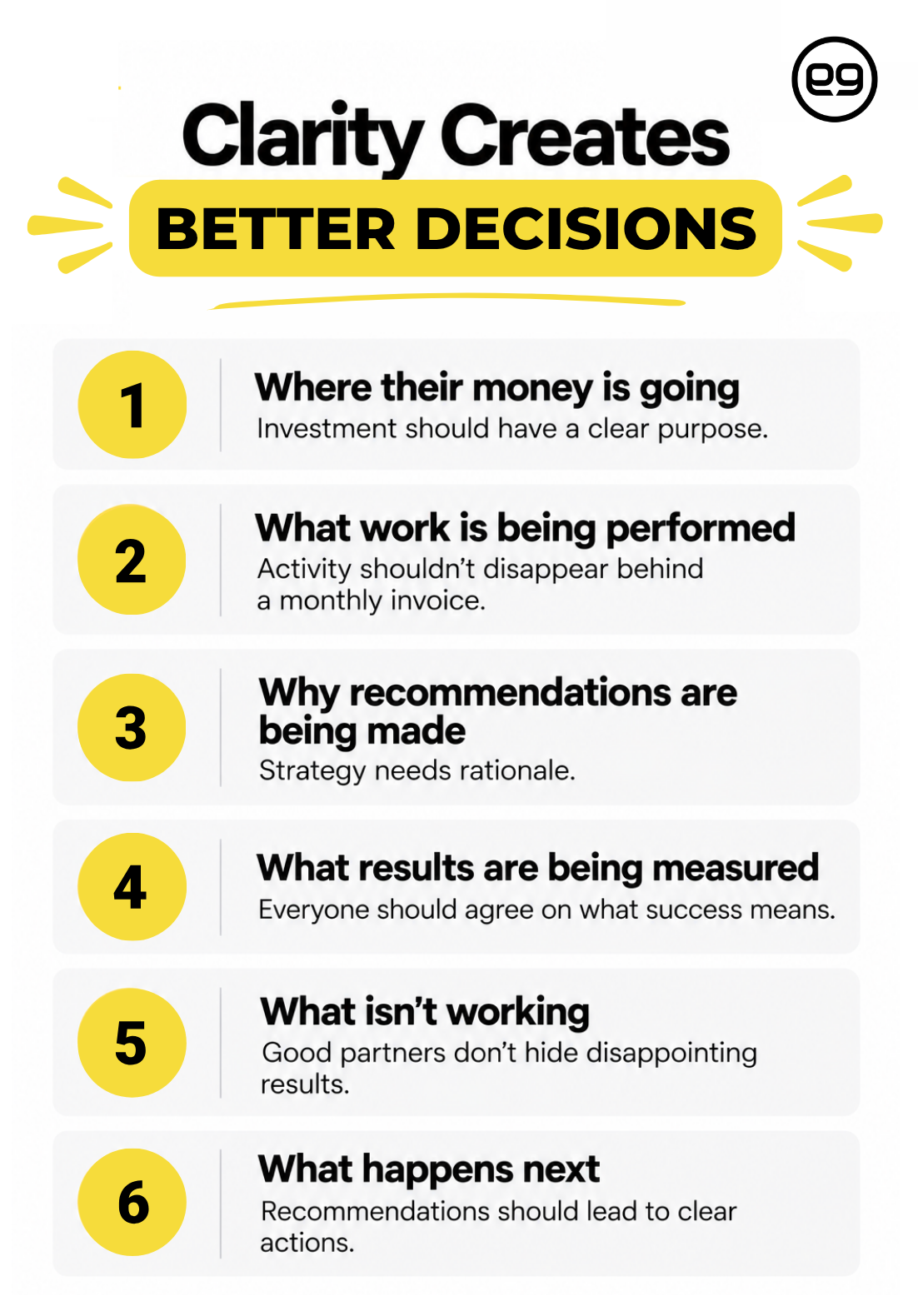
- Where their money is going: Investment should have a clear purpose.
- What work is being performed: Activity shouldn’t disappear behind a monthly invoice.
- Why recommendations are being made: Strategy needs rationale.
- What results are being measured: Everyone should agree on what success means.
- What isn’t working: Good partners don’t hide disappointing results.
- What happens next: Recommendations should lead to clear actions.
Marketing transparency only strengthens an agency’s authority.
Questions Every Business Should Ask Its Marketing Agency
Whether you’re currently working with a marketing agency or holding initial meetings to hire one, you need to have the right questions in place to see what they’ll be like to work with.
Always feel comfortable enough to ask your marketing consultant:
- Can You Explain That Without the Jargon? A good agency should welcome the opportunity to clarify an idea.
- Why Are You Recommending This? Ask how it connects to your customers, competitors, objectives, or business.
- What Business Problem Does This Solve? If nobody can connect a recommendation to a problem or opportunity, it’s not necessary.
- What Happens If We Don’t Do It? An experienced agency should be able to explain the business consequences of acting or not acting.
- How Will We Know If It’s Working? Define measurement first. If you don’t, success can conveniently become whatever the agency says it is later.
- What Do You Need From Us? Your agency should identify the knowledge, feedback, and expertise it needs from your team.
- Can You Give Me an Example? If something still doesn’t make sense, a good expert should be able to illustrate it using a real-world situation.
Signs Your Agency May Be Hiding Behind Jargon
If you’ve ever sat through a meeting and felt like your agency was talking at you, not talking to you, it’s time to consider that it might not be the best fit. Instead of being the person who asks “what the heck are you talking about,” you can watch for the signs below.
When thinking about your current agency, if you’ve experienced any of the items below, it might be time to find someone who wants to help you succeed:
- Every explanation creates more questions: Expertise should eventually produce clarity, not endless confusion.
- Simple questions get complicated answers: Complexity may be masking the absence of a clear answer.
- Meetings are filled with undefined acronyms: Communication should be designed for the audience in the room.
- You can’t ask questions: A healthy agency relationship encourages curiosity.
- Recommendations don’t reflect business goals: Tactics without rationale are just activity.
- Reports contain data but no conclusions: Analytics should tell you what happened, why it matters, and what to do next.
- “Trust us” is the explanation: Trust should be earned through transparency, not demanded.
- You leave meetings more confused: Good advisors should help make difficult decisions clearer.
You Shouldn’t Need a Marketing Degree to Understand Your Marketing Agency
Complicated work often requires complicated thinking. It doesn’t require complicated explanations. A great digital marketing agency should explain, educate, and listen, connecting decisions to business outcomes you understand.
At e9digital, we believe clients make better decisions when they understand:
- What we’re recommending
- Why we’re recommending it
- What it’s supposed to accomplish
You bring expertise in your business. We bring expertise in ours.
Our job isn’t to impress you with terminology. It’s to bring those two kinds of expertise together to create smarter strategies and better results.
Marketing Agency Jargon FAQs
Why do marketing agencies use so much jargon?
Marketing has a lot of specialized terminology, and agencies often use it because it’s familiar shorthand among industry professionals. But jargon can also make ideas sound more sophisticated, discourage questions, or hide a lack of clear thinking. A good agency knows the terminology but doesn’t rely on it to impress you. It explains what things mean, why they matter, and how they affect your business.
Is using complicated language a sign of expertise?
Not necessarily. True expertise often shows up in someone’s ability to explain a complicated subject clearly without sacrificing accuracy.
What should I do if I don’t understand my marketing agency’s recommendations?
Ask them to explain the recommendation in plain language, why they’re suggesting it, what business problem it solves, and how success will be measured. A good agency should welcome those questions.
How much should a business owner understand about digital marketing?
You don’t need to become an SEO specialist, developer, or media buyer. But you should understand what you’re investing in, why it matters, what outcome is expected, and how performance will be evaluated.
Why is clear communication important in an agency relationship?
Clear communication allows clients to contribute their own expertise, evaluate recommendations, make informed decisions, and understand whether their marketing investment is producing results.
What does a transparent marketing agency look like?
A transparent agency clearly explains its recommendations, costs, strategies, performance metrics, successes, challenges, and next steps rather than asking clients to simply trust the web design process.