
Google Isn’t the Only Place Your Customers Are Searching Anymore
“ChatGPT is another place your customers are looking for answers. If your business deserves to be in that conversation, your job is to give it enough reasons to put you there.” — Conrad Strabone, Founder & Chief Happiness Officer | e9digital
For years, getting found online largely meant getting found on Google. That’s a thing of the past. People increasingly use ChatGPT and other AI platforms to research products, compare services, learn about companies, and answer questions they once typed into traditional search engines.
That creates an entirely new visibility question for businesses: When someone asks ChatGPT about your industry, does your company become part of the answer?
Learning how to rank in ChatGPT starts with understanding that there isn’t one universal page of results where every business occupies a fixed position. AI search visibility is about increasing the likelihood that your brand, expertise, products, services, or content will surface when someone asks a relevant question.
Think of it less like fighting for the best seat on the subway and more like making sure your train stops near where your customers are going. You want your business connected to the right questions, topics, and conversations.
First Things First: Can You Actually “Rank” in ChatGPT?
When marketers talk about “ranking in ChatGPT,” they’re borrowing familiar SEO language to describe something that works differently from traditional search.
Depending on the query and ChatGPT experience, your company could be mentioned, recommended, cited as a source, or omitted entirely.
This is because ChatGPT responses are probabilistic rather than fixed. There is less than a 1-in-100 chance of getting the same list of brands in any two responses when the same prompt is run 100 times.1 That is like reshuffling a deck of cards each time you ask the question. The same cards may appear, but the order and combination can change.
So the objective isn’t to reach “position one.” It’s to increase the likelihood that your business becomes part of relevant AI-generated answers.
Why ChatGPT Visibility Matters
People aren’t only using ChatGPT to write emails or summarize documents. They’re using AI to gather information, research purchases, compare options, understand complicated subjects, and make decisions.
If your company consistently surfaces in relevant AI conversations, that creates another opportunity to introduce your brand and expertise to prospective customers. If it doesn’t, competitors may become part of those conversations instead.
Here’s why ChatGPT SEO is becoming relevant to businesses:
- Discovery is changing: The familiar journey of “question to Google to search results to website” is becoming “question to ChatGPT to answer to brand or source to website.”
- AI can shorten research: Instead of opening ten tabs and manually comparing ten websites, someone can ask an AI platform to synthesize the options.
- Brand discovery happens before the click: A prospect can potentially learn about your company before ever visiting your website.
- AI visibility reinforces awareness: A relevant brand mention can introduce your business even when it doesn’t immediately generate a website visit.
- Competitors compete for the same answer: AI search adds another competitive layer to traditional organic visibility.
AI is becoming so prevalent that the popular SEO tracking platform Ahrefs now also measures AI visibility using mentions, citations, impressions, and AI Share of Voice, reflecting how discovery extends beyond getting ChatGPT to link to your website.2
What Does “Ranking” in ChatGPT Actually Look Like?
There’s more than one way to show up. Traditional SEO gives marketers familiar ways to think about visibility: rankings, impressions, clicks, and search positions. ChatGPT is different. A company can surface in several ways depending on the question being asked and the type of response being generated.
Here are the major forms of SEO for ChatGPT visibility:
- Brand Mention: Your company is mentioned when ChatGPT discusses a relevant topic or category.
- Recommendation: Your company appears when someone asks for businesses, products, services, or solutions to consider.
- Citation: A page from your website is surfaced as a source supporting an answer.
- Expertise: Your research, data, definitions, or other useful information becomes relevant to an AI-generated response.
- Product or Service Discovery: Your offering surfaces during a user’s research or comparison process.
- Branded Research: Someone discovers your company elsewhere and then asks ChatGPT specifically about your business.
ChatGPT SEO vs. Traditional SEO
Good news: You don’t have to throw out your SEO playbook. If you’ve been implementing traditional SEO to help your website rank higher on Google, then that will help you rank higher on ChatGPT as well.
ChatGPT and SEO overlap in several important ways. Useful content, technical accessibility, authority, search intent, strong site architecture, and clear information remain important foundations.
What’s changing is the destination. Traditional SEO focuses heavily on earning visibility in search results and driving clicks. AI search also requires thinking about whether information is clear, credible, useful, and structured in ways that make it valuable when an AI system assembles an answer.
Traditional SEO still contributes several important building blocks:
- Technical Accessibility: Your website needs to be accessible to systems discovering web content.
- Content Quality: Useful, original, well-supported information remains the foundation.
- Topical Authority: Demonstrate meaningful expertise around a subject instead of publishing disconnected articles solely to target keywords.
- Search Intent: Understand what someone actually wants from a search or question.
- Website Architecture: Create clear relationships between pages so your expertise is easier to understand.
- Internal Linking: Connect supporting topics and important pages logically.
- External Authority: Build relevant links and credible mentions across the web.
Here’s an example of how important keywords are to ranking on ChatGPT. Seer Interactive analyzed more than 300,000 keywords, narrowed them to 10,000 relevant questions, and tested those questions through OpenAI’s GPT-4o API. Brands ranking on page one of Google showed roughly a 0.65 correlation with LLM (large language model, which is how ChatGPT runs) mentions. Bing rankings also showed a positive correlation of approximately 0.5 to 0.6.3
TL;DR: Don’t abandon SEO to chase ChatGPT. Traditional search visibility and AI visibility aren’t identical, but the data suggests they’re connected.
How to Rank in ChatGPT: The 7 Biggest Factors
If you want to understand how to rank higher on ChatGPT, focus less on hacks and more on the areas that can make your business more useful, authoritative, and discoverable.
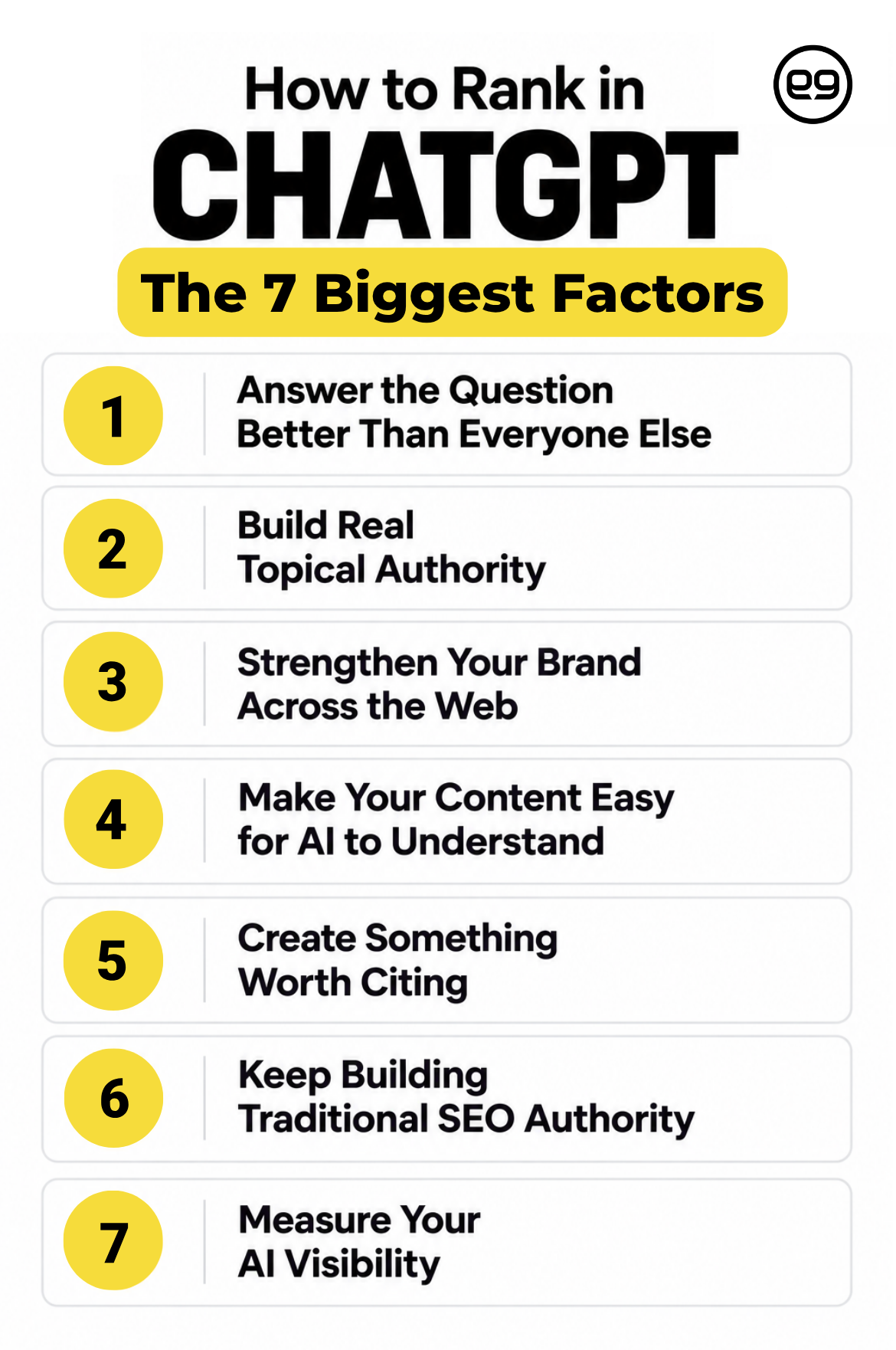
1. Answer the Question Better Than Everyone Else
AI search is fundamentally answer-oriented. If someone asks a specific question, content that directly and clearly addresses it has more utility than a page that repeatedly uses the right keyword without providing a useful answer.
Focus on structuring content for LLM extraction and making key information clear and easy to identify, rather than optimizing solely around conventional search presentation.4 A few ways to make your answers stronger:
- Put Important Answers High On The Page: Give readers the information they came for instead of making them dig through five subway stops worth of setup.
- Use Question-Based Headings: Turn actual customer questions into article headers.
- Give A Concise Answer First: Provide the direct answer, then expand with explanation, evidence, examples, and context.
- Answer Logical Follow-Up Questions: Anticipate what someone is likely to ask next, and answer those as well.
Strong content doesn’t make people work to find the answer. It gets them where they need to go and gives them a reason to keep reading.
2. Build Real Topical Authority
If a business wants to become associated with a subject, one optimized page is rarely the whole strategy. Build a connected body of useful content demonstrating expertise across the questions, problems, and subtopics surrounding that subject.
More content does not automatically equal more AI visibility. Ahrefs’ analysis of 75,000 brands found an extremely weak correlation of approximately 0.194 between the number of pages on a website and AI visibility.5
If you want to improve your ChatGPT ranking, depth matters more than simply adding pages. For example, instead of publishing one article about “Small Business SEO,” build expertise around:
- Technical SEO: Make sure search engines and AI systems can access and understand important content.
- Local SEO: Help businesses become more visible for geographically relevant searches.
- Content Marketing: Answer the questions prospective customers are actually asking.
- Internal Linking: Connect related pages so topics and relationships are easier to understand.
- Website Performance: Keep pages fast, functional, and accessible.
- Conversion Optimization: Turn visibility into inquiries, leads, and sales.
- GEO: Improve your visibility within generative AI experiences.
- AI Search: Create content that can support AI-generated answers.
- Analytics: Measure what people find, use, and respond to.
Think of it like the subway map. One isolated stop does not make much of a network. The value comes from how everything connects.
3. Strengthen Your Brand Across the Web
Your website isn’t the only website that matters.
Your own site will naturally say your company is knowledgeable, experienced, and worth hiring. Third-party references provide a different kind of authority. Relevant press coverage, industry mentions, expert citations, reviews, partnerships, videos, directories, and backlinks all contribute to the broader digital footprint surrounding your brand.6
Look for opportunities to build authority through:
- Relevant media coverage, expert interviews, and partner websites
- Industry publications, professional associations, and directories
- YouTube, podcasts, and conference appearances
- Original research, client reviews, backlinks, and unlinked brand mentions
The goal isn’t to spray your company name everywhere. It’s to build credible evidence across the web that your business belongs in the conversation.
4. Make Your Content Easy for AI to Understand
Clear organization makes information easier for people to scan and easier for machines to interpret. That doesn’t mean writing robotic content for AI. It means organizing useful information so the subject, answer, evidence, and relationships between ideas are obvious.
For ChatGPT and SEO, clarity is an advantage. Use structures like:
- Descriptive Headings: Tell readers exactly what a section answers.
- Concise Definitions: Answer definitional questions directly.
- Short Explanatory Passages: Avoid burying the useful information inside massive paragraphs.
- Lists: Use them when information genuinely belongs in a sequence or group.
- Tables: Make structured comparisons easier to understand.
- FAQs: Answer natural-language questions prospective customers may ask.
- Statistics: Support important claims with credible evidence.
- Source Citations: Make information easier to verify.
- Clear Brand Information: Keep company names, services, locations, and other facts accurate and consistent.
The best New York experiences feel fast and intuitive, even when there’s a lot happening around you. Katz’s Deli is always packed, but the shop runs like a well-oiled machine because they have clear processes. Your content should make it just as easy for readers to know where to look and what to do next.
5. Create Something Worth Citing
“The goal isn’t to stuff a website with more content. It’s to say the right thing, clearly enough and credibly enough, that a person or an AI can understand why you belong in the answer.” — Conrad Strabone, Founder & Chief Happiness Officer | e9digital
AI already has plenty of generic content. The internet doesn’t need another article that simply rearranges the first ten Google results. Businesses can build stronger authority by publishing original information, which helps them stand apart from thousands of interchangeable pages.7
Focus on opportunities such as:
- Proprietary Data: Analyze information only your company has access to.
- Surveys: Ask customers or industry professionals meaningful questions.
- Original Research: Investigate something your audience genuinely wants to understand.
- Case Studies: Show real problems, solutions, and outcomes.
- Expert Commentary: Add firsthand professional knowledge to the conversation.
- Firsthand Experience: Explain what actually happened when you built, tested, or implemented something.
- Useful Statistics: Create data that journalists, bloggers, and other websites may want to reference.
6. Keep Building Traditional SEO Authority
The arrival of ChatGPT doesn’t mean businesses should abandon traditional SEO and start optimizing exclusively for AI. Strong organic visibility, useful content, technical accessibility, and established authority can provide a foundation for visibility across traditional and AI-powered search.
The opportunity isn’t SEO or GEO. It’s creating a digital presence strong enough to work across both.
If your goal is ranking higher on ChatGPT, keep investing in SEO fundamentals:
- Technical SEO: Keep important pages accessible, indexable, fast, and technically sound.
- Search Intent: Understand what prospective customers actually want.
- Quality Content: Create pages that genuinely answer those needs.
- Internal Linking: Connect related topics and establish relationships between your content.
- Backlinks: Earn legitimate links from relevant and authoritative websites.
- Brand Building: Strengthen recognition and branded demand beyond your own website.
- Content Updates: Keep high-value resources current and accurate.
AI is constantly evolving, so it may be changing the route customers take. That doesn’t mean you rip up the tracks that are already working.
7. Measure Your AI Visibility
Since ChatGPT doesn’t have fixed rankings, businesses need a different way to measure progress.
Instead of asking whether you moved from position seven to position three, track whether your company appears more frequently across relevant conversations, earns more citations, gains visibility for strategically important topics, and increases its share of AI visibility compared with competitors.
Here’s what to measure:
- Brand Mentions: How frequently does your company appear in relevant AI responses?
- Citations: How often does ChatGPT cite pages from your website?
- AI Share of Voice: How frequently does your brand appear compared with competitors?
- Topic Visibility: Which topics and questions does ChatGPT associate with your company?
- Cited Pages: Which pages on your site earn the most AI citations?
- Competitor Visibility: Which questions surface competitors but don’t surface you?
- AI Referral Traffic: How much measurable website traffic arrives from AI platforms?
- Accuracy: When AI discusses your company, is the information correct?
Traditional rank tracking isn’t enough for AI search because ChatGPT responses aren’t fixed. Build a representative set of prompts that matter to your business and measure visibility across those conversations. An agency that excels in using AI can help you set up systems to track your ChatGPT rankings.
And be skeptical of any agency promising guaranteed ChatGPT rankings or claiming that a few phrases, massive amounts of AI-generated content, or some secret prompt can guarantee visibility. Just like with traditional SEO, there is no shortcut to ChatGPT ranking.
Rank on ChatGPT With Help From e9digital
“There’s no lottery ticket for ChatGPT rankings. You have to do the same hard things that have always built great businesses: earn credibility, answer the right questions, and give people a reason to trust you.” — Conrad Strabone, Founder & Chief Happiness Officer | e9digital
AI search visibility depends on making your business easier to understand, strengthening your expertise, and creating genuinely useful information. If your competitors are showing up in AI answers and you aren’t, they’re getting introduced to potential customers before you ever enter the conversation.
e9digital helps businesses close that gap. We combine SEO, content strategy, Generative Engine Optimization, website development, and AI to help your company get found more often, show up for the right questions, and turn that visibility into real business opportunities.
Want to know where you’re showing up, where competitors are beating you, and what to do next? Talk to e9digital about SEO, GEO, and AI search visibility.
Frequently Asked Questions
How Do You Rank in ChatGPT?
There isn’t a traditional fixed ranking system in ChatGPT, so the goal is to increase how often your business is mentioned, recommended, or cited for relevant questions.
The best way to improve that visibility is to make your expertise easy to find and understand. Publish useful content that directly answers customer questions, build strong topical authority, keep your website technically sound, earn credible mentions across the web, and create original information that gives other sources a reason to reference your business.
Is ChatGPT SEO Different From Google SEO?
Yes, but they overlap. Traditional SEO focuses heavily on earning organic search visibility.
ChatGPT SEO or GEO expands the goal to include earning mentions, recommendations, and citations within AI-generated answers. Strong traditional SEO can still provide an important foundation for both.
How Do I Get My Website Cited by ChatGPT?
There is no guaranteed formula.
Increase your opportunities by creating useful, clear, original, current, well-supported content that directly answers relevant questions and is technically accessible. Also study which types of pages and sources ChatGPT currently cites for the topics important to your business.
Can I Guarantee My Business Will Appear in ChatGPT?
No.
ChatGPT responses can vary based on the question, context, and information available at the time. There is no fixed ranking system and no reliable way to guarantee that a specific business will appear in every relevant response.
That’s why businesses should be cautious of anyone promising guaranteed ChatGPT rankings. A better strategy is to improve the factors that can increase your chances of being mentioned, recommended, or cited over time.
Resources
- https://ahrefs.com/blog/how-to-rank-on-chatgpt/
- https://help.ahrefs.com/en/articles/15501968-ai-visibility-metrics?utm_source=chatgpt.com
- https://www.seerinteractive.com/insights/what-drives-brand-mentions-in-ai-answers?
- https://ahrefs.com/blog/how-to-rank-on-chatgpt/
- https://ahrefs.com/blog/how-to-rank-on-chatgpt/
- https://ahrefs.com/blog/how-to-rank-on-chatgpt/
- https://neilpatel.com/blog/how-to-rank-your-website-on-chatgpt/