

Stop Using a Digital Marketing Strategy That Limits You
Almost everybody knows how to play tic-tac-toe. There are only nine spaces. The possibilities are limited. After you’ve played enough times, you know most of the moves. Even a chicken could master the game if it played it enough.
That’s exactly what makes it a terrible model for a marketing plan.
Some agencies work the same way. New client? Use the same website structure, SEO checklist, paid search strategy, and content formula. Same messaging exercise. Change the logo, swap a few words and move on.
Chess is different. The board may start the same every time, but what happens next depends on the moves being made around you.
Everyone is moving, including:
- Your customers
- Your competitors
- Technology
- Search
- Your business
A real marketing strategy has to move with them.
A Playbook Isn’t a Strategy
“If an agency gives every client the same answer, it probably stopped listening a long time ago.” — Conrad Strabone, Founder & Chief Happiness Officer | e9digital
There’s nothing wrong with an agency having a process. In fact, it should. At e9digital, our team has a defined website design process that helps us move through each project quickly and in a way everyone can understand. Things like research, discovery, strategy, and development can—and probably should—follow an established process.
But process and digital strategy aren’t the same thing.
Process asks: How do we approach the problem?
Strategy asks: What should we do about this particular problem?
An experienced agency should have a repeatable process for discovering a non-repeatable answer.
Same Industry Doesn’t Mean Same Business
No two businesses of any industry are the same. Think about how different a personal injury law firm operates versus an estate planning attorney. Even two direct competitors may have completely different:
- Strengths and weaknesses
- Customers and geographic footprints
- Margins and sales cycles
- Reputations and competitive advantages
- Service mixes and growth objectives
So why would they need exactly the same marketing strategy? The answer is, they don’t! The pieces for the marketing plan may look similar, but the position isn’t. Your strategy needs to account for where your business actually sits on the board.
Your Competitors Get a Vote
Hard truth: you don’t control the whole board because your competitors don’t have to follow your marketing plan. Instead, competition is a cycle. You launch a new service, a competitor cuts prices. You improve SEO, three competitors increase their content investment. You start dominating one search category, and a new competitor enters the market.
One thing is true: change is constant.
- Google changes.
- AI search changes how prospects discover businesses.
- Customer expectations change.
For example, 45% of people used AI during a recent purchase.1 AI only became mainstream in the last few years, and it’s already completely changing how people shop.
Strategy can’t assume everyone else stays still while you execute your five-year plan. That’s why website strategy has to account for what other businesses are actually doing, not what you assumed they’d do six months ago.
Stop Asking, “What Usually Works?”
It’s understandable that as a business owner, you want to know about proven tactics. So, you may be tempted to ask, “What usually works for companies like ours?”
It’s a reasonable question. But an even better one would be, “What is most likely to work for us?”
Because “best practices” describe what generally works. A customized marketing strategy determines what you should do.
For example: A competitor dominates Google organically. Should you immediately try to beat them at SEO? Maybe. Or perhaps they’re vulnerable somewhere else. Maybe paid search presents a faster opportunity, their website converts poorly, their messaging is generic, there’s a niche they’ve ignored, or their reputation is weak. Odds are that your best opportunity isn’t to attack their strongest square.
Chess players don’t make moves because they’re the popular moves. They make moves because they’re right for the position.
Best Practices Can Become a Trap
“Best practices are a starting point. If everybody in your industry is doing the same thing, following them won’t help you stand out.” — Conrad Strabone, Founder & Chief Happiness Officer | e9digital
Best practices are useful until everybody follows them. Then they become standard practices. Every professional-services homepage starts sounding like:
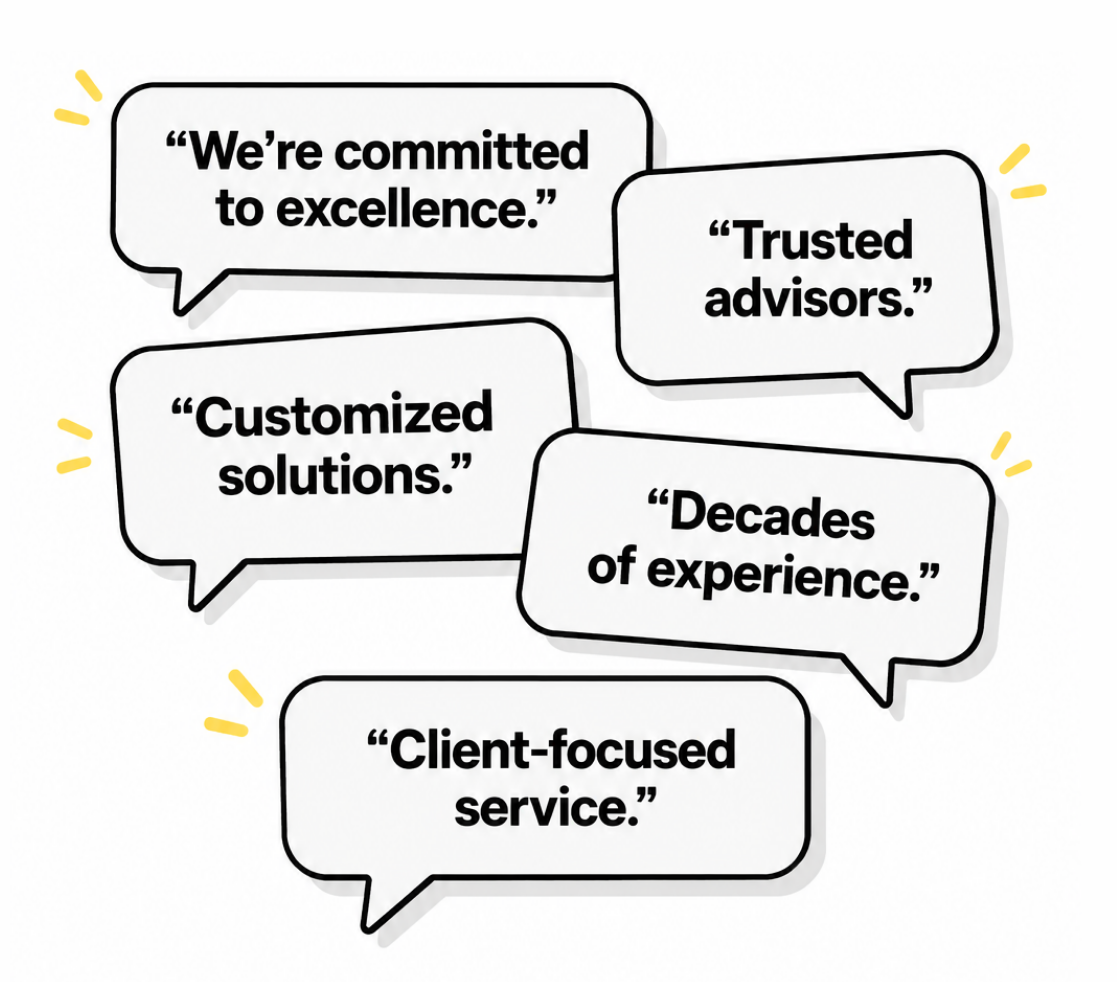
- “We’re committed to excellence.”
- “Trusted advisors.”
- “Customized solutions.”
- “Decades of experience.”
- “Client-focused service.”
Every competitor has the same navigation, stock imagery, service pages, claims, CTAs, and blog topics. Eventually, following the playbook perfectly can make you completely indistinguishable, and your agency can end up making its clients blend into a crowd it helped create.
Templates Are Efficient. Differentiation Isn’t.
It’s easy to understand why tic-tac-toe marketing exists. It’s efficient.
An agency has already solved the problem once. Why not sell that solution 100 more times? Production gets faster. Margins may improve. But ask an important question:
Who benefits most from that efficiency?
The agency, or the client? There is nothing inherently wrong with efficiency or reusable systems. The problem comes when operational efficiency starts dictating marketing strategy. Your business shouldn’t become easier for the agency to create at the expense of blending in for your customer.
Your Marketing Channels Are Pieces, Not Strategies
SEO, PPC, Linkedin, email, and your website aren’t your strategy in and of themselves. Instead, they are tools to build your strategy, similar to chess pieces on the board. Strategy determines:
- Which pieces matter most
- Where they should be deployed
- How they work together
- What objective they’re serving
- Where resources should be concentrated
- When priorities should change
Owning all the chess pieces doesn’t mean you know how to play chess.
A company can be doing SEO, PPC, email, content and social simultaneously and still have no coherent competitive analysis marketing strategy connecting them.
Don’t Make Every Move at Once
Chess isn’t won by moving every piece simultaneously. Neither is marketing. More than 50% of B2B buyers say they’re likely to switch suppliers if they don’t get a smooth experience across channels.2 If every channel receives enough investment to exist, odds are it’s not getting enough to accomplish anything (or appeal to your audience).
Triggers to change your strategy include when:
- Customer or search behavior changes
- A new competitor enters or a current one makes meaningful moves
- A channel becomes significantly more expensive or conversion rates decline
- The business enters a new market or launches a new services
- Sales priorities change or data reveals an assumption was wrong
A good agency will tell you when these triggers are happening, because a competitive marketing strategy requires prioritization. Your agency should figure out: What move matters most right now, and what becomes possible after we make it? That creates the blueprint for marketing channel investment and strategy changes.
What Does a Chess-Playing Agency Look Like?
A chess-playing agency will understand the logical moves that are specific to your audience. They will:
- Ask questions before prescribing solutions
- Study competitors and customer behavior
- Identify the business’s actual strengths
- Challenge assumptions and prioritize opportunities
- Explain tradeoffs and measure results
The goal of this approach is more original positioning, tailored messaging, strategic thinking, and greater differentiation.
This is because not every new trend deserves a reaction. Just because your competitor launched a podcast doesn’t mean that you also need to. Part of strategy is deciding what you aren’t going to do.
Hire an Agency That Plays Chess for Your Business
Every client’s position is different. That’s why our team at e9digital doesn’t pull the next strategy off the shelf. Instead, we study the board to understand your business before making the first move. Learn more about how our strategic marketing agency builds custom website design and marketing strategies and schedule a call with our team today.
FAQ
What is the difference between a marketing strategy and a marketing tactic?
A strategy defines what the business is trying to accomplish, where the opportunity lies and how it plans to compete. Tactics are the individual actions—such as SEO, PPC, email, content and social media—used to execute that strategy.
Why doesn’t the same marketing strategy work for every business?
Businesses differ in their customers, competitors, positioning, goals, resources, reputation, geography and sales process. A tactic that works extremely well for one company may address a problem another company doesn’t have.
Should a marketing agency use a standard process?
Yes. A repeatable process can make research, planning, execution and measurement more disciplined. But the process should lead to a strategy tailored to the business—not a predetermined answer.
How often should a digital marketing strategy change?
A strategy shouldn’t change simply because of short-term noise. But businesses should revisit it when meaningful changes occur in customer behavior, competition, technology, business objectives or performance data.
How do I know if my marketing agency is using a cookie-cutter strategy?
Look for recommendations made before substantial discovery, limited competitor analysis, identical tactics across clients, generic messaging and an inability to clearly explain why a particular recommendation makes sense specifically for your business.
Why is competitor research important to marketing strategy?
Because your strategy doesn’t operate in isolation. Understanding where competitors are strong, weak and undifferentiated can help identify where your business has the best opportunity to stand out.